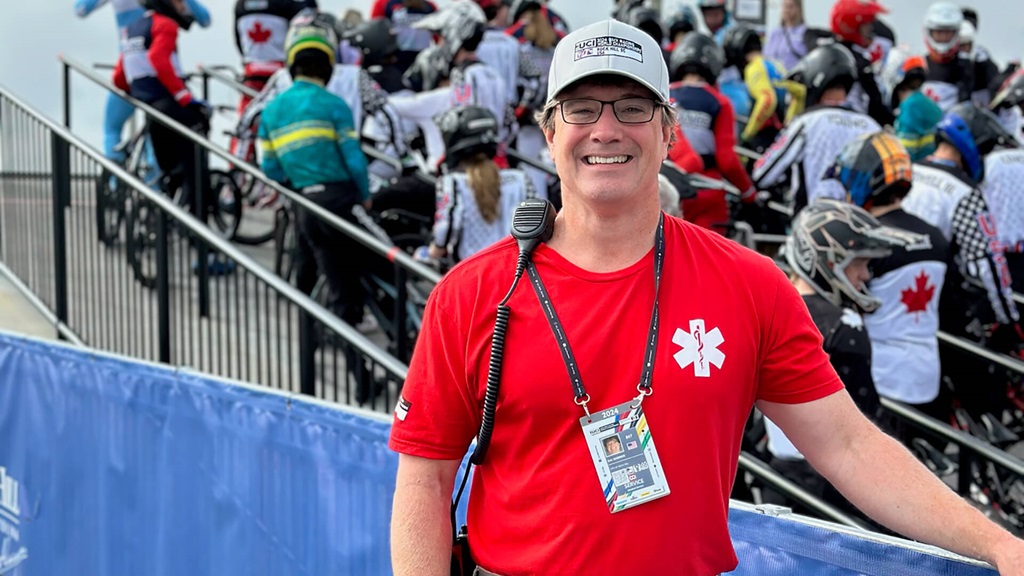
“Olympic athletes don’t have unlimited chances,” says Eric Warren, MD, medical director of the Atrium Health Musculoskeletal Institute Sports Medicine Network. “With the Olympics happening only once every four years, that timing alone changes how injuries, recovery and return-to-play decisions are approached.”
Why Olympic sports medicine is different
 While professional athletes compete every season, Olympic athletes often train for years for just one opportunity. For many, missing one Olympic cycle could mean missing their only opportunity to have the world see them compete at the highest level.
Dr. Warren experienced this firsthand while serving as chief medical officer for the 2024 BMX World Championships, an Olympic qualifying event, where he treated athletes competing for world championship titles, elite ranking points and a limited number of spots in the Paris 2024 Olympic Games.
“When you’re caring for athletes at that level, the pressure is intense,” he says. “Every decision matters. The stakes are incredibly high, and the margin for error is incredibly small. What may seem like a routine decision in other settings has layers of complexity.”
Layers of oversight, with little room for error
Caring for elite athletes isn’t just about diagnosing and injury and writing a prescription. There are layers of coordination happening behind the scenes.
“You’re not just treating a knee or shoulder,” Dr. Warren explains. “You’re thinking about the mechanics of the sport they play, the competitions schedule and what’s allowed under anti-doping rules. Every decision can affect eligibility.”
In Olympic sports medicine physicians work closely with athletes, coaching staff and the U.S. Olympic & Paralympic Committee (USOPC). Every medication, even those you can get over the counter, must be carefully reviewed under the World Anti-Doping Agency (WADA) guidelines.
For example, beta-blockers which are commonly used to treat high blood pressure, are banned in sports like biathlon because they lower heart rate and can improve shooting accuracy.
“It’s not always obvious,” Dr. Warren says. “One small oversight can have major consequences.”
Why return-to-play decisions can look different
Because the Olympics are so infrequent and such a huge event on the world stage, return-to-play timelines during an Olympic year are often more aggressive, though still carefully managed.
“It’s a constant balance as a provider,” says Dr. Warren. “You want to prioritize long-term health for a patient, but you are also aware that this may be a once-in-a-lifetime opportunity for someone.”
Beyond the Olympic stage
Most people won’t compete for an Olympic medal, but everyday athletes feel pressure too.
“While not the Olympics, everyday athletes face their own big moments,” says Dr. Warren. “It might be a championship game, a marathon someone has trained months for or simply wanting to stay active without setbacks.”
For athletes and weekend warriors, that pressure often shows up as:
- Playing through pain to finish a season
- Returning to activity too quickly after an injury
- Ignoring symptoms because they don’t want to fall behind
Dr. Warren continues, “I played competitive football, so I often pushed myself through injuries. I understand what my patients are experiencing not only physically, but emotionally as well.”
Recovery isn’t a race
One of the biggest lessons from Olympic sports medicine is that recovery is not the same for every individual.
“While we often can provide estimates, there’s no universal timeline for healing,” Dr. Warren says. “Two people can have the same injury and need very different return-to-play plans. That’s why working with a provider who understands your goals and customizes a treatment plan is key.”
Olympic sports medicine may operate on the biggest stage, but its core principles apply to athletes everywhere: individualized care, informed decision-making and respect for long-term health.
Consider seeing a sports medicine specialist if you have pain that lasts more than a few days, swelling, weakness, or aren’t sure when it’s safe to return to activity.


