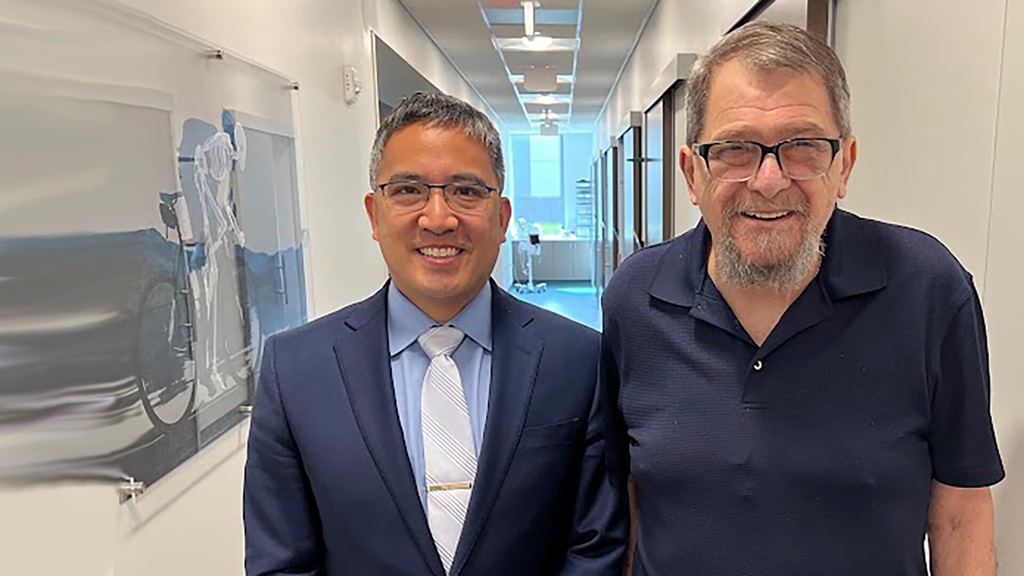

After decades working on his feet as an electrician and later managing highway toll booths, Normand Paradise was looking forward to slowing down and enjoying retirement with his family.
Instead, a hip replacement led to a rare complication that left him unable to walk.
“It all went downhill less than a month after the surgery,” Paradise said. “I went from being active to not being able to stand or even get dressed on my own.”
Paradise developed heterotopic ossification, a condition in which bone forms in soft tissue. Over time, the extra bone caused his hip joint to fuse, leaving him confined to a wheelchair.
“I was stuck in a wheelchair for months,” he said. “Simple things like getting in and out of bed were painful. You don’t realize how much independence you lose until it’s gone.”
As his condition worsened and other health challenges arose, he and his wife decided to move to North Carolina to be closer to family and seek care.
 “At that point, we were just trying to find someone who could help him get his life back,” his wife said.
That search led them to Dr. Eric Lee, an orthopedic surgeon specializing in hip and knee replacement at Atrium Health Lake Norman Hospital. He recognized the severity and rarity of Paradise’s condition.
“What Normand experienced is uncommon but serious,” Dr. Lee said. “Cases like this require a highly individualized approach to restore function and mobility. We focus on reducing pain, improving joint movement where possible, and helping patients regain independence.”
Treatment requires patience. Surgeons must wait until the abnormal bone stops growing before it can be safely removed. For Paradise, that meant more than a year without being able to walk.
 On the day he turned 77, Dr. Lee and the care team performed a complex surgery at Atrium Health Lake Norman Hospital to remove the excess bone and restore movement in the joint.
“There was a significant amount of bone that had to be carefully removed while protecting the surrounding nerves and blood vessels,” Dr. Lee said. “The goal is to restore function while minimizing the risk of complications or recurrence.”
Just hours before surgery, Paradise received targeted radiation therapy to help prevent the bone from growing back, followed by medication during his recovery.
The results came quickly.
“Within a couple of weeks, I was able to start moving again,” Paradise said. “The first time I got up, my wife and I both cried. I hadn’t done that in over a year.”
For his wife, the change has been just as meaningful.
 “I never thought we’d get this back,” she said. “Now he’s helping take out the trash again, sitting at the dinner table with me for dinner. We couldn’t even do that before.”
Before his health challenges, Paradise stayed active. He enjoyed hunting, fishing, and spending time with his family. Losing that independence was one of the hardest parts of his journey.
Now he is focused on rebuilding strength and returning to the routines he once took for granted.
“Just being able to sit at the dinner table with my family every night means everything,” he said.
Dr. Lee said cases like Paradise’s highlight the importance of specialized care and coordination across teams.
“This type of recovery takes a coordinated approach,” Dr. Lee said. “From surgery to radiation therapy to rehabilitation, every step is important in helping patients regain their mobility and quality of life.”


