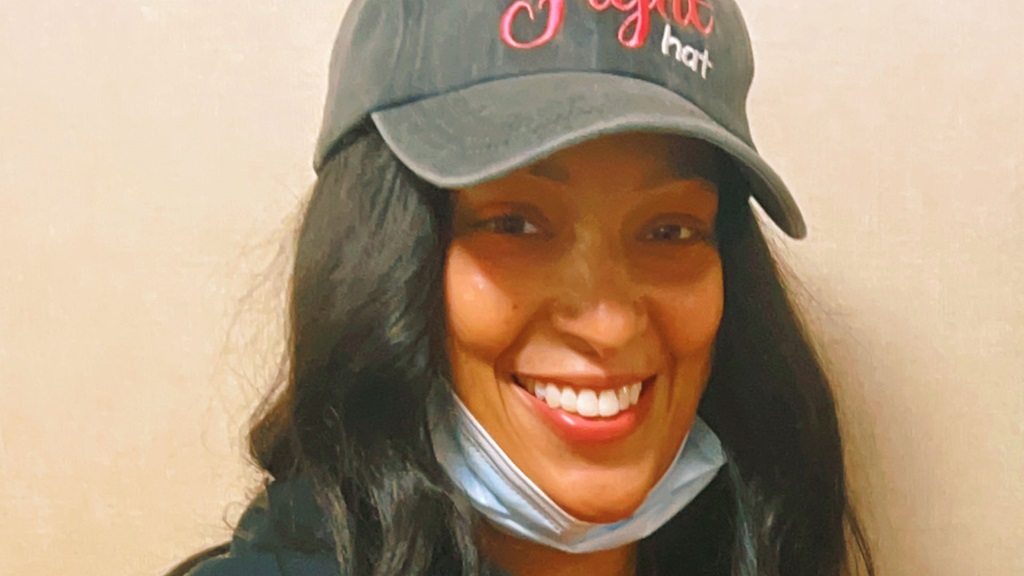
Krystal Peoples, 44, has always made her health a priority. She exercises regularly, eats well and stays on top of her preventive care. So when she learned she had breast cancer at 42, the news felt impossible.
“I didn’t feel anything, I was completely healthy and had no issues at all,” says Krystal.
Because of her family history — her paternal grandmother had breast cancer and her mother had bone cancer — Krystal began getting mammograms around age 38. In April 2023, she got the call that changed everything: she had breast cancer. Krystal was so shocked that she asked the nurse if she had called the right number.
“I’m very active,” she says. “My husband and I work out all the time, we watch what we eat. I don’t smoke or drink. I was just like, ‘How can this be? I’m healthy and nothing is wrong with me.’”
Krystal’s breast cancer diagnosis and treatment plan
 Krystal met with Dr. Arielle Heeke, a medical oncologist at Atrium Health Levine Cancer, who explained that her diagnosis was early-stage HER2-positive breast cancer. Krystal’s treatment included neoadjuvant chemotherapy with HER2-targeted therapy, followed by a partial mastectomy and sentinel lymph node biopsy, reconstructive surgery, radiation and additional HER2-targeted maintenance therapy. Krystal also underwent genetic testing, which found no known breast cancer mutations.
“I feel very fortunate that everyone on my medical team — from Dr. Heeke to my surgeons and every person I interacted with — was part of my journey,” she says. “I was able to triumph and go through treatment like I did because of my care team. I didn’t feel like another cancer patient — I felt like a person and like they were truly invested in my journey.”
Throughout treatment, Krystal tried to maintain as much normalcy as possible. She often took conference calls during chemotherapy and stayed active for as long as her body allowed.
“I’d do eight hours of chemotherapy and then the next morning, I would get up at 7 a.m. and go to the gym,” she says. “Even through treatment, I worked out as long as I could, but then I started getting weak and nauseous. I didn’t have the energy to work out anymore, so I had to listen to my body and do what was best for me.”
In all, Krystal underwent eight rounds of chemotherapy, two surgeries, 30 rounds of radiation and 13 additional rounds of IV therapy. She was officially declared cancer-free in September 2024.
Why mammograms matter
Krystal’s experience is a reminder that breast cancer can affect younger women, even those who feel healthy and have no symptoms.
“Breast cancer is on the rise in younger women,” says Dr. Heeke. “It is a slow rise, but a real rise. And we are seeing that breast cancer can happen to anyone, not just those with a strong family history or other medical comorbidities. We are seeing it in young healthy women with no significant family history.”
Researchers are still working to better understand why breast cancer diagnoses are increasing in younger women. In the meantime, Heeke urges women to pay attention to their bodies and speak up if something feels off.
“It’s important for women to monitor their bodies and seek expert care with their gynecologist or primary care provider if they notice breast changes,” she says. “While most breast changes in young women are not cancerous, we don’t want to miss the changes that are cancerous.”
For women 40 and older, Heeke says annual mammograms are essential.
The healing power of supportive oncology

Along with medical treatment, Krystal leaned on supportive oncology services to help her cope physically and emotionally.
“Cancer can rock your world and change a lot of what you once knew about yourself and the world you live in,” says Heeke. “Supportive oncology was designed to help usher patients through those changes with grace.”
Krystal turned to nutrition classes after chemotherapy, when she wanted to feel more in control of her health and focus on lowering her risk of recurrence.
“During chemo, you’re at the mercy of what you can keep down — it might be a hamburger one day and a salad or a protein shake the next,” she says. “Once I got past chemo, it was important to me to get control of my health and I knew it started with my diet.”
She also explored acupuncture, massage and counseling services. Massage offered relief from neuropathy and a much-needed emotional escape.
Therapy also helped her process the emotional impact of cancer, especially the toll it took on her self-image.
“I was struggling with not recognizing this woman in the mirror, from my hair loss to the weight I’d gained to the scars,” says Krystal. “It was so nice to have a therapist who was knowledgeable about what I was going through, especially with my body image. She made me feel understood and gave me supportive tools, like writing a letter to my body, which was a breakthrough for me to release a lot of the feelings I had about myself and my body.”
Supportive oncology services can vary based on a person’s needs, and may include:
- Nutrition services
- Mental health support
- Sexual health services
- Side effect management
- Acupuncture
- Yoga
- Music therapy
- Tai chi
- Spiritual care
- And more
Krystal’s message to other women
Krystal now encourages other women not to ignore changes in their bodies or delay screenings out of fear.
“Listen to your body and take action,” she says. “Don’t allow a busy schedule or fear of the unknown keep you from finding out what’s going on with your body.”
She also hopes women will give themselves permission to care for their emotional well-being, not just their physical health.
“Make sure you take care of not only your physical health, but also your emotional and mental health,” she says. “It’s OK to not be strong in every moment and to share your feelings.”
Learn more about breast cancer care and supportive oncology services at Levine Cancer.


