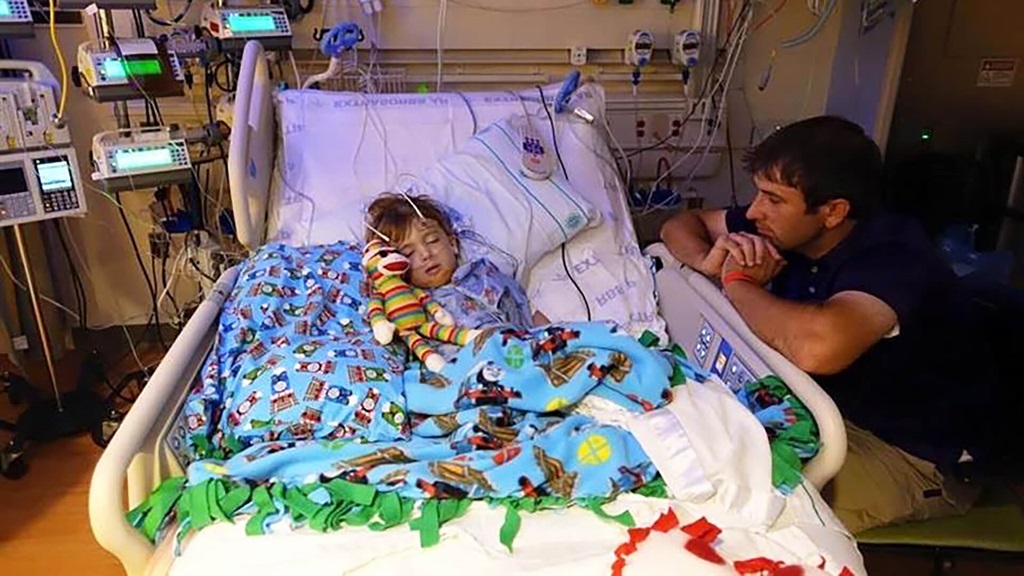
When Megan and Wes Perkins look at their son today, they don’t just see a teenager who loves video games and dreams of trying sports for the first time. They see a boy who’s survived more than most adults ever will.
“He’s kind, tenderhearted and sensitive,” Megan says. “He wants to make everyone happy before himself. His friends always look forward to hanging out with him.”
At 13 years old, Landon is thriving at home in Virginia, surrounded by his brothers and the everyday rhythms of being a kid. But his story began before he ever entered the world.
An unexpected discovery
 When Megan was 12 weeks pregnant, routine bloodwork suggested something was off. They ruled out Down syndrome, but there were still no clear answers, so her doctors decided to monitor things closely. A few weeks later, at her 20‑week ultrasound, the Perkins family hoped to confirm the baby’s gender. Instead, the appointment took a sharp turn.
“The doctor determined something was different,” Megan says. “Within minutes, everything changed.”
Landon was diagnosed with hypoplastic left heart syndrome, a rare congenital condition in which the left side of the heart doesn’t develop properly. Babies born with the condition rely on a series of surgeries to reroute blood flow so the heart can function.
The plan was to deliver in Virginia in October 2012. But while visiting family in Charlotte late that summer, Megan went into labor at just 32 weeks. She delivered at Atrium Health Carolinas Medical Center, and Landon was transferred to Atrium Health Levine Children’s Hospital for specialized cardiac care.
A series of surgeries
 Landon was taken to the neonatal intensive care unit (NICU) immediately after birth. 12 hours later, Megan and Wes were able to meet their son.
“To us, he was just perfect,” Megan says.
Just five days after he was born, Landon was intubated and prepared for open‑heart surgery.
He had his Norwood procedure at 6 days old, the first of three surgeries used to reroute blood flow for babies born with hypoplastic left heart syndrome. It’s the most complex stage and helps the right side of the heart take over the work of the missing left side. He spent 30 days in the hospital before going home.
At 5 months old, he returned for his Glenn procedure, which connects the upper body’s main vein directly to the lungs. This reduces strain on the heart and usually helps babies have more stable oxygen levels.
Then, a few days after his third birthday, the family returned to Charlotte again for Landon’s Fontan procedure, the final planned surgery for single‑ventricle patients. It directs the rest of the body’s blood flow to the lungs without passing through the heart, allowing the single ventricle to pump oxygen‑rich blood to the body.
Throughout early childhood, Landon also had several heart catheterizations, which let his care team check pressures, blood flow and the health of his Fontan circulation.
“For a kid with hypoplastic left heart syndrome, he really did well for a long time,” Megan says.
A mother’s instinct
 For years, Landon lived a full childhood. He loved video games and theater, spent time with friends and grew up alongside his two younger brothers. But when he was 12 years old, Megan began noticing subtle changes.
“I kept saying something isn’t right,” Megan says. “He was tired, he couldn’t keep up with the sports he loved, he wasn’t thriving like he should have. He had already missed the last three weeks of school that spring because he was so exhausted.”
At his most recent checkup his echocardiograms looked stable. But Megan trusted her instinct.
“I called his team at Levine Children’s and told them we were coming for an appointment to figure out what was going on,” Megan says. “I knew what I was seeing every day and just didn’t think Landon was OK. I packed up the boys, and we planned to stay for the long haul.”
They traveled from Virginia and arrived at Levine Children’s Hospital in Charlotte on June 9, 2025, where Landon went straight to the cardiovascular intensive care unit.
Dr. Jameson Dyal with Atrium Health Levine Children's HEARTest Yard Congenital Heart Center says determining when a patient with Fontan circulation needs a heart transplant is complex.
“In Landon’s case, his symptoms had been progressing for some time,” Dyal says. “His ability to exercise had decreased significantly, and he was much more fatigued than usual.”
Weight loss was another key sign. Dyal explains that when the heart is struggling, the body uses calories to compensate rather than to grow.
“By the time Landon was admitted, he had begun losing weight, which told us his heart was reaching its limit.”
Despite medication changes and aggressive nutritional support, Landon didn’t improve.
“That was the sign that the heart he was born with had taken him just about as far as it could,” Dyal says.
A test of courage and care
 Landon had known for years that he would eventually need a heart transplant. When the time came, he understood how sick he was.
“He knew he was ready because his body just felt so bad,” Megan says.
The evaluation process was long and emotional, but Landon was officially put on the pediatric transplant list on June 24.
The average wait time for a pediatric heart transplant can vary significantly based on individual circumstances and the urgency of the condition, with some patients waiting several months to a year for the right match. But for Landon, the match came much quicker than anyone expected — coming the very next day after he was listed.
“Once he was on the list, it went much faster than we expected,” Megan says. “I had packed for an entire year. We had no idea what this would be like.”
The transplant was successful, but recovery brought its own challenges. Landon needed dialysis, and he experienced delirium in the days that followed.
“You come in thinking you’re prepared for it, but I was an emotional disaster,” Megan says. “He didn’t know who we were … It was something I had never experienced in my life. Looking back, I truly don’t know how I mentally made it through watching him go through this.”
At one point, Megan realized she needed to step away from the hospital to steady herself.
“You feel like you have to be there every second of every day, but I was starting to spiral,” Megan says. “Landon’s care team made it feel like it was OK to take care of myself, too. They assured me that what my son needed was a steady parent, and that meant stepping away for a little while to regroup.”
Landon was discharged July 17 and stayed with family in Charlotte for several months to be close to his follow‑up care. His doctors cleared him to return home to Virginia in October.
Dyal says that stretch in Charlotte was one of Landon’s biggest hurdles.
“Patients who receive heart transplants have to stay close to the hospital for several months in case they need unplanned care,” Dyal says. “Landon and his family had the support of grandparents and many others, but being away from home presents emotional and practical challenges that not every family faces.”
The team at Levine Children’s Hospital worked closely with the family to help them navigate this time.
“We had to be flexible with some of those challenges while he was here with us in Charlotte, and thoughtful about planning for anything that might come up once he eventually went home,” Dyal says.
A full life ahead
 Now, less than a year after his transplant, Landon is in physical therapy and works hard at home to regain his strength. Like all heart transplant patients, he’ll continue taking daily medications to protect his new heart and prevent rejection. His care team monitors his levels closely, but the further he gets from transplant, the fewer medications he needs and the more time he can go between checkups.
“While we initially saw Landon every week, he now only needs to come in every four weeks,” Dyal says. “Ultimately, all of our transplant patients see us several times a year so we can support them and their families in whatever way they need.”
Landon’s future feels wide open. He’s dreaming about sports, reconnecting with friends and discovering what his new body can do. Dyal has watched this transformation firsthand.
“Landon looks like a million bucks,” Dyal says. “Most patients who need heart transplants haven’t felt well for months or even years beforehand. Seeing him not only get back to where he was, but start to exceed what was possible before, is one of the real joys of this work.”
What excites Dyal most is lies ahead.
“The further we get from his transplant, the better he’s going to feel,” Dyal says. “I’m excited to see Landon get back to the things he couldn’t do before and look forward to seeing him follow his goals and dreams without being limited by a struggling heart.”
Megan and Wes share that hope. They continue to reflect on the boy who always puts others first, the one whose friends light up when he walks into the room.
“He’s forever grateful,” Megan says. “He knows he’s been given a great gift, and our hope for him is that he continues to carry this big heart wherever life leads him.”
Learn more about pediatric cardiology and heart surgery Atrium Health Levine Children’s Congenital Heart Center.


