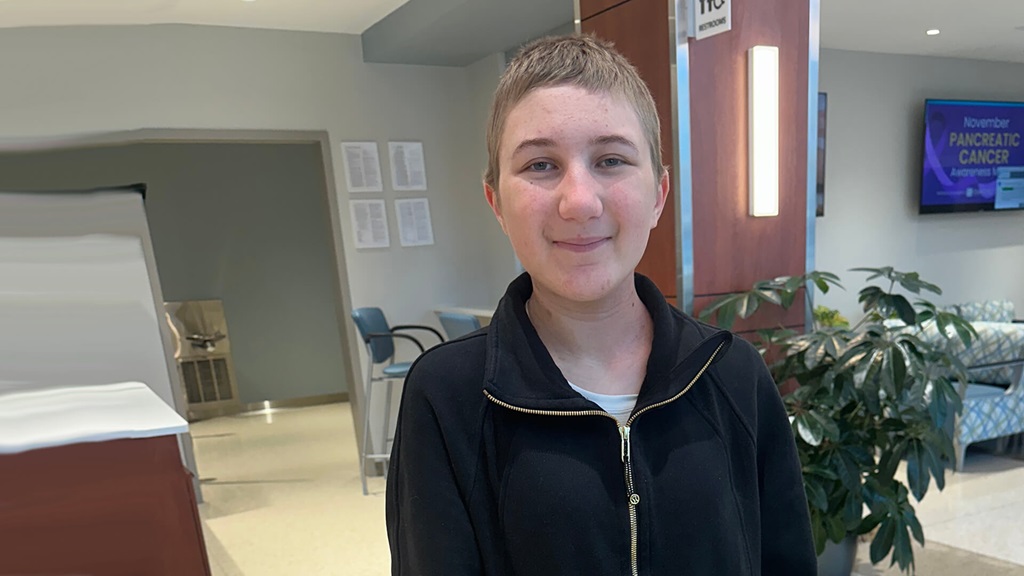
In early December 2025, the Atrium Health Levine Cancer Proton & Advanced Radiation Center completed proton beam therapy on its 100th patient since launching the new therapy option in 2024. That milestone patient was 15-year-old Ava Schmid, who received treatment for Hodgkin lymphoma.
Ava and her family live in eastern North Carolina and were grateful to have access to a proton therapy center just a few hours from home.
A shocking diagnosis at the end of middle school
In May 2024, Ava and her parents noticed swelling on the left side of her neck. They took her to her pediatrician for an evaluation. After ordering a chest X-ray and blood work, Ava’s pediatrician referred the family to their local medical center for further testing. A biopsy revealed that the then-8th-grader had Hodgkin lymphoma.
“We were all shocked,” says Melissa Schmid, Ava’s mom. “She asked me, ‘Am I going to die?’ I told her no, that we’re going to fight it.”
By the end of that month, Ava had her port placed, underwent a bone marrow biopsy and started a four-month chemotherapy regimen. Ava’s scans in October revealed the cancer was still present, but the chemo was working.
At the beginning of January 2025, the cancer had, unfortunately, returned, which meant Ava was now considered “high risk.” She began more intensive inpatient chemotherapy, staying in the hospital from Monday through Friday for three rounds of treatment.
After completing inpatient chemotherapy, Ava underwent a stem cell transplant. Subsequent scans were negative and they looked the best they ever had, says Melissa.
Undergoing proton therapy for Hodgkin lymphoma
 Even with her clear scans, Ava’s doctors recommended radiation therapy to reduce her chance of recurrence, given that her cancer was considered “high risk.” That recommendation brought Ava and her parents to Dr. Roshan Prabhu, a radiation oncologist at Atrium Health Levine Cancer.
“Before we went to Charlotte, Ava’s doctor told us we could do regular radiation in Greenville, where we were, or we could go to Charlotte for proton therapy,” says Melissa. “He felt strongly that proton therapy was safer for her because of her age and where the cancer was located in her body. It was very important that we chose a treatment that protected her thyroid, breast tissue, lungs and heart.”
Dr. Prabhu explains the difference between proton therapy and traditional radiation.
“Proton beam therapy is a very specific way of delivering radiation therapy that uses something called charged particles, or protons in this case,” he says. “95% of radiation treatments in this country use X-rays to treat tumors, which can go through normal tissue when they exit the body. With proton treatment, once the beams enter the body, they give their dose and then they stop.”
Because Ava’s treatment area included sensitive organs, minimizing radiation exposure to healthy tissue mattered both now and long-term.
“In someone who is young or in someone where you’re treating very sensitive areas, such as the neck and chest near the heart and lungs, being able to spare those normal tissues reduces the risk of long-term complications,” says Prabhu. “That’s what drove the decision for proton therapy in Ava’s case.”
Ava’s proton beam treatment at Levine Cancer
The family began proton therapy at Levine Cancer, traveling three hours and 15 minutes each way. Ava began treatment in November 2025, receiving proton therapy five days per week for four weeks, with 20 treatments in total.
The family stayed nearby during her treatments, though they returned home on the weekends to give Ava a sense of normalcy and to spend time with Ava’s 11-year-old brother.
Ava’s treatment went remarkably smoothly, with no side effects other than some slight fatigue.
“It was a pleasure to take care of her,” says Prabhu. “She’s mature beyond her years and a very smart, goal-oriented young lady. The fact that she’s able to maintain some normalcy, school and her day-to-day life is a testament to her and her family.”
How Ava’s life has changed
Cancer treatment disrupted Ava’s life. She was diagnosed with Hodgkin lymphoma at the end of her 8th grade school year. She missed her 8th grade dance and championship soccer game. Because she was still undergoing treatment at the start of the new school year, she had to do homebound schooling during 9th and 10th grade.
Even so, Ava kept showing up for the parts of her life she could control.
“She’s still a straight-A student and her GPA is more than 4.0,” says Melissa. “Through all of her treatments, she continued her school work and her teachers know her really well.”
Ava’s favorite subject in school is math and she loves art, particularly drawing with pencil and paper.
Ava’s friends have stayed in touch and their parents often reach out to Melissa.
“I’m starting to think she’s bionic,” jokes Melissa. “She’s strong and pushes through.”
The care experience and the community behind it
For the Schmids, the day-to-day experience at Levine Cancer mattered just as much as the technology.
“Everyone at Levine Cancer was great,” says Melissa. “They all communicated very well, and you can tell they enjoy their jobs and are very knowledgeable. They form special bonds with their patients.”
Ava connected with her care team over their shared love of Wicked and Taylor Swift.
“Red is my favorite Taylor Swift album,” says Ava. “I listened to it a lot in the car and during my proton treatments.”
Melissa says support from family, friends and neighbors helped them keep life as steady as possible.
“My husband and I split time so one parent was always at home with our son and one was with Ava,” says Melissa. “We also have a lot of support from our friends, family and neighbors.”
Looking ahead, the family is hopeful about what 2026 will bring.
“We’re ready for a new year with hopefully a lot fewer hospital stays and unknowns,” she says. “We’re in a good spot now.”
What the 100th patient milestone represents
As Prabhu reflects on treating more than 100 patients since the center opened, he says, “Every situation is different. We’ve had 100 distinct situations and stories.”
He also notes what this access can mean for families, especially those who previously might have faced much longer travel or fewer options.
“Before our proton center was open, Ava would have potentially not gotten radiation because it would have been deemed too toxic or she would have gotten traditional X-ray radiation treatment that would have increased her side effects,” he says. “Or she would have had to travel outside the state for proton therapy.”
Prabhu emphasizes that the success of the program takes a village, including coordinators, social workers, pediatric oncology colleagues, therapists, dosimetrists, physicists, nurses and Ronald McDonald House staff.
“We’ve accomplished a lot,” says Prabhu. “It’s really the first step in a much larger goal of bringing this treatment to more patients in the Carolinas and beyond.”
Learn more about proton therapy at Levine Cancer.


