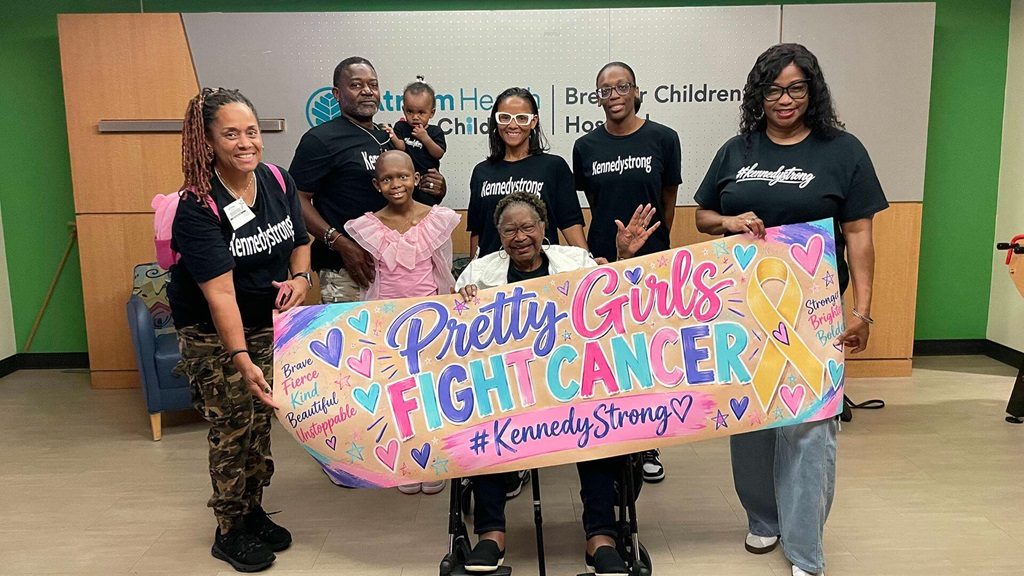
 Lakisha Walker knew something wasn’t right with her 9-year-old daughter, Kennedy.
Kennedy was active on her cheerleading team, loved tumbling and was always on the go. So when she complained of a headache the day after her birthday sleepover, Lakisha took notice.
“It was the first time she’d ever complained of a headache,” she says.
After the headaches continued for several days, Lakisha took Kennedy to her pediatrician, who suspected a virus. But Kennedy didn’t improve and her headaches continued. The following week, her teacher noticed she still wasn’t feeling like herself.
Lakisha returned to the pediatrician’s office, where she was reassured that Kennedy was OK.
“They said everything was OK, so I gave her Tylenol and didn’t know what else to do,” says Lakisha.
Then Kennedy’s teacher called again. When Lakisha picked her up from school, Kennedy immediately vomited outside.
Lakisha initially called the pediatrician to ask for a referral to a neurologist. But she decided she couldn’t wait for another appointment and took Kennedy to the nearest emergency department.
There, the family learned Kennedy had a brain tumor.
“They sent us to Brenner Children’s around midnight that night,” says Lakisha.
A rare pediatric brain cancer diagnosis
Additional scans showed the seriousness of Kennedy’s condition. She was diagnosed with pineoblastoma, a rare, aggressive cancer that develops in the pineal region of the brain. By the time Kennedy was diagnosed, the cancer had also spread to her spine.
The tumor presented another challenge: its location and extensive blood supply made surgery particularly complex.
“The tumor was highly vascular, meaning it contained many blood vessels, and it was located in a particularly delicate area of the brain where surgery carries significant risks,” says Dr. Mariah Wright-Nadkarni, pediatric oncologist at Atrium Health Levine Children’s Brenner Children’s Hospital.
Kennedy’s care team consulted with pediatric neuro-oncology experts across the country before developing her treatment plan. Because removing the tumor immediately would have carried significant risks, the team began with chemotherapy to shrink it and make surgery safer.
Kennedy had a port placed on Nov. 17, 2025 and began chemotherapy the following day. After two rounds, the tumor had shrunk enough for surgeons to operate. They were able to remove 95% of the tumor, leaving only a small portion that was closely intertwined with blood vessels.
“[The surgeon] told us chemotherapy and radiation would take care of that small portion,” says Lakisha.
Kennedy also underwent advanced molecular and genetic testing of her tumor. The results helped her care team further characterize her cancer and better understand its molecular features.
 A multidisciplinary treatment plan
Kennedy’s treatment required several specialties working together.
After chemotherapy and surgery, she received 30 rounds of proton craniospinal irradiation, a specialized form of radiation directed at the brain and spinal canal because her cancer had spread to her spine. She then completed four additional rounds of chemotherapy beginning in April.
Throughout treatment, Kennedy had regular scans so her doctors could closely monitor how she was responding.
“She got scans between each round of chemo and the scans were looking good,” says Lakisha. “They were confident the treatment was working.”
On Sept. 4, 2026, Kennedy rang the bell marking the end of chemotherapy, surrounded by family, friends and her cheerleading squad.
“It was very emotional,” says Lakisha.
The family had received especially meaningful news the day before.
“We found out the day before she rang the bell that there was no evidence of active disease in her brain or spine,” says Lakisha. “Everything is pretty much in remission at this point. It was a long journey.”
Caring for Kennedy beyond her cancer
Getting treatment for a serious illness at 9 years old meant Kennedy needed support beyond chemotherapy, surgery and radiation.
Her care team included a therapist and child life specialists who helped her understand and cope with what was happening in ways appropriate for her age.
“It was a lot for her,” says Lakisha. “She was used to being around other kids and her cheerleading team. She had moments where she was scared she was going to pass away.”
Her family, friends and faith also helped her through treatment. Kennedy’s faith grew during her illness and she asked her parents if she could be baptized.
“She got baptized that Sunday,” says Lakisha.
For Wright-Nadkarni, Kennedy’s experience illustrates why children with complex cancers benefit from a team that can address both their medical and emotional needs.
“Kennedy’s experience highlights the importance of specialized pediatric cancer care and the power of a multidisciplinary team approach,” says Wright-Nadkarni.
“Team Kennedy” included pediatric oncology nurses, advanced practice providers, pediatric neuro-oncologists, radiation oncologists, neurosurgeons, psychologists, social workers, chaplains and other specialists working together throughout her care.
The team also saw firsthand the role Kennedy’s family played. Lakisha and her husband, Philip, were by Kennedy’s side throughout treatment while also caring for their two other children.
“Just as inspiring has been the unwavering support of her parents, Lakisha and Philip,” says Wright-Nadkarni. “They were by her side through every hospitalization, clinic visit and difficult moment, providing constant love, encouragement and advocating for her. Together with their incredible support system of family and friends, they created a strong foundation of support that helped Kennedy navigate the challenges of treatment with grace and optimism.”
 Looking forward to cheerleading, crafting and being a kid
Kennedy will turn 10 in October, nearly a year after her cancer experience began. Her mom believes it won’t be long before she’s tumbling again.
“She’s already doing cartwheels and small flips in the grass outside,” she says.
Wright-Nadkarni remembers Kennedy finding moments of joy even during an intensive course of treatment.
“It is an honor to be part of Kennedy's care team,” says Wright-Nadkarni. “Throughout her treatment journey, I have been continually inspired by her positivity, courage and resilience. She faced an extraordinarily intensive course of therapy with remarkable strength, all while continuing to do the things she loved, including crafting, cheerleading and dancing, often in her Ugg boots.”
Kennedy will continue to see Wright-Nadkarni for follow-up scans every few months. For now, her family is grateful to see her returning to the things she loves.
“She loves to cheer, craft and go to church,” says Lakisha. “She’s such a sweet girl.”
Kennedy’s mom also hopes their experience encourages other parents to speak up when they believe something isn’t right with their child.
“A mother’s intuition is real,” says Lakisha. “Don’t let doctors send you away. If you feel like something is wrong and you’re not getting the information you need, take your child somewhere else. Get a second or even a third opinion.”
“Everyone at Brenner’s was amazing, so professional and helpful anytime my husband and I had questions,” says Lakisha.
Learn more about pediatric cancer care at Atrium Health Levine Children’s Brenner Children’s.


