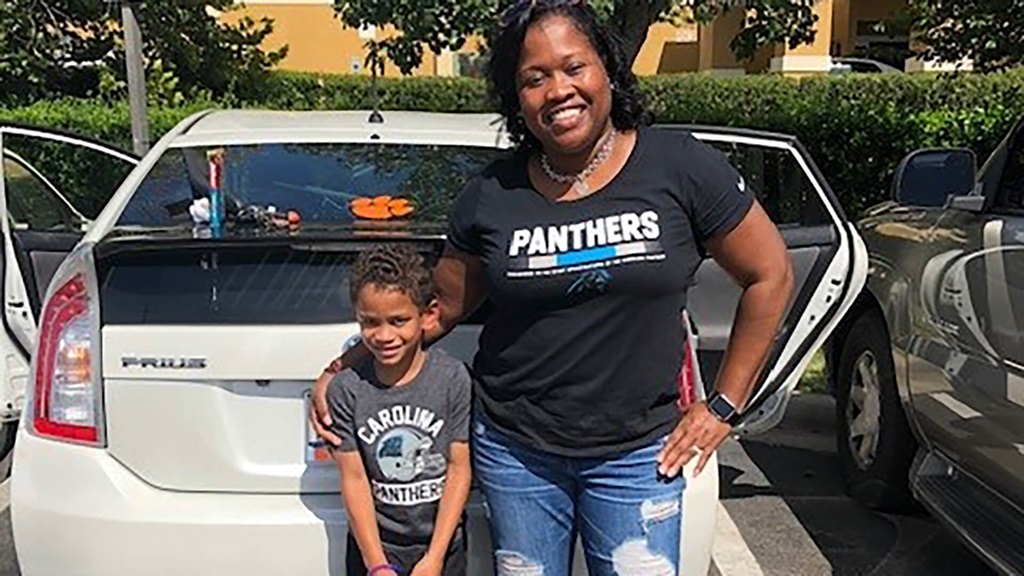
 In January 2023, Valerie McWilliams began having pain in her upper right arm.
After a month of discomfort, she saw her primary care physician, who referred her to an orthopedic surgeon. X-rays of her elbow and shoulder didn’t reveal a cause. But Valerie’s pain continued to worsen. Even riding in a car over a bumpy road became extremely challenging.
“I was in so much pain,” says Valerie, now 53.
She received a cortisone injection in her shoulder and went through physical therapy, but her symptoms didn’t improve. Looking for answers, Valerie asked to see a spine specialist, who ordered an MRI.
The imaging revealed lesions on her ribs and led to a referral to Atrium Health Levine Cancer. Additional scans showed that Valerie’s right humerus, the bone in her upper arm, was fractured.
Further testing revealed the underlying cause: multiple myeloma, a blood cancer involving plasma cells that can damage and weaken bones.
Valerie met with Dr. Manisha Bhutani, a hematologist and medical oncologist at Atrium Health Levine Cancer, to discuss treatment. Before beginning chemotherapy, Valerie saw an orthopedic oncologist, who placed a titanium rod in her arm to stabilize the fracture.
“Valerie’s fracture told us that the myeloma had been affecting her bones for some time before the diagnosis,” says Bhutani. “Multiple myeloma can weaken the normal structure of bone, making fractures occur with little or no significant injury. In her case, the fracture was an important clue that led us to uncover the underlying disease.”
Treating Valerie’s multiple myeloma
Valerie began chemotherapy and received infusions for four months. When developing her treatment plan, Bhutani considered the biology of Valerie’s myeloma, how extensively it had affected her bones, her overall health and her personal goals.
“We wanted an approach that would control the disease quickly, help her bones heal and give her the best chance for a deep and durable response,” says Bhutani.
In September 2023, Valerie underwent a stem cell transplant.
Today, she continues to see Bhutani for regular follow-up appointments and monitoring. Valerie describes her current health in encouraging terms.
“I’ve been doing good,” she says. “They don’t say ‘remission’ because multiple myeloma is a blood cancer, but they don’t detect any signs of multiple myeloma within me.”
Because a stem cell transplant can affect the immune system, Valerie remains mindful of reducing her exposure to illness. She works from home and wears a mask in public.
Most importantly, she says, she “feels great.”
Finding support throughout multiple myeloma treatment
 Valerie relied on her husband, family and friends throughout her treatment. She also sought support through Levine Cancer, including working with a therapist and trying acupuncture, Healing Touch and massages through the Division of Supportive Oncology.
She was determined to maintain a positive outlook, even when treatment brought side effects and setbacks.
“My mantra was having faith that I will heal and this too shall pass,” she says.
“What stands out most is Valerie’s positive attitude and resilience,” says Bhutani. “She has faced difficult challenges with remarkable determination while staying engaged in her care.”
Valerie also had something special to look forward to. She had planned a safari in South Africa to celebrate her 50th birthday, but her diagnosis and treatment forced her to postpone the trip.
In 2024, after completing treatment, she was finally able to go.
“That was my motivation,” says Valerie. “I’d been waiting all my life to do this and I wasn’t going to let cancer [stop me]. I’m going to live.”
When to seek care for concerning symptoms
 Looking back on the months she spent searching for the cause of her arm pain, Valerie encourages others to speak up when something doesn’t feel right.
“I always tell people to prioritize their health,” she says. “Also, advocate for yourself. If you’re not getting answers or things are moving really slowly, don’t be afraid to ask for another doctor and a second opinion. Once they got me over to Levine Cancer, things worked super-fast.”
Bhutani also encourages people to seek medical attention for concerning or persistent symptoms.
“Multiple myeloma symptoms can be subtle and easily attributed to more common problems,” she says. “Persistent bone pain, fatigue or unexpected fractures should not be ignored. Early evaluation can make a significant difference.”
Valerie now sees Bhutani every three months. Her care team continues to monitor her disease markers, bone health and overall well-being.
“Valerie has done very well overall,” says Bhutani. “As with all myeloma patients, we continue to monitor her disease markers closely, watch for any signs of recurrence and pay attention to her bone health and quality of life. Our goal is not only to keep the myeloma under control, but also to help her stay active and well.”
Treatment options for multiple myeloma have expanded significantly in recent years, giving care teams more ways to manage the disease.
“Multiple myeloma treatment has advanced tremendously over the past two decades,” says Bhutani. “While it remains a serious diagnosis, we now have more effective therapies than ever before. Just as importantly, no one should feel they have to navigate the journey alone. Building a strong support system and working closely with a knowledgeable care team can make a meaningful difference.”
Learn more about multiple myeloma care at Levine Cancer.


