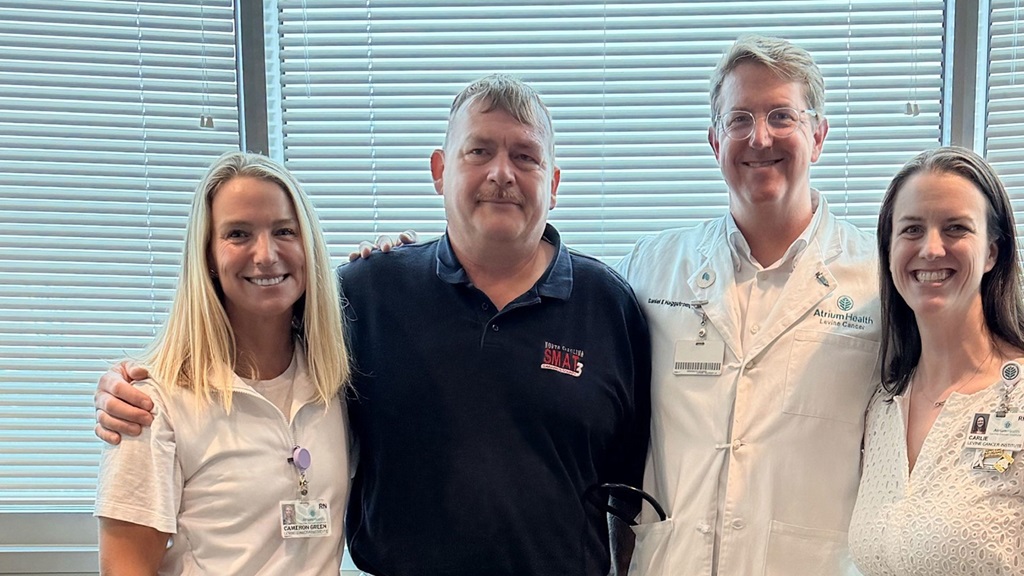
After spending 30 years responding to medical emergencies as a paramedic in Cabarrus County, DougBickerstaff never imagined he'd be the one needing emergency care.
In February 2026, Doug was teaching a continuing education class for EMTs and paramedics at the Rowan County EMS Station when he felt a sudden pop in his left arm, followed by excruciating pain.
Earlier that month, Doug had developed arm pain that eventually sent him to the emergency department at Atrium Health Cabarrus. Imaging revealed a suspicious lesion in his upper arm bone, and he was scheduled for surgery. In the meantime, he'd continued teaching with his arm in a sling.
But during class that afternoon, his arm fractured, causing him to collapse in pain. His students quickly came to his aid.
“I was teaching PowerPoints when it broke,” he said.
Doug was transported to Atrium Health Cabarrus, where doctors worked to manage his pain. A few days later, Dr. Ryan Voskuil, an orthopedic oncology surgeon at Atrium Health Levine Cancer, performed surgery to stabilize the fractured bone with a metal rod and took a bone sample to get answers about what caused the fracture.
An unexpected lung cancer diagnosis
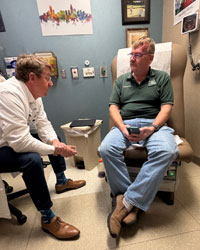
Following surgery, Doug met with Dr. Daniel Haggstrom, an oncologist at Levine Cancer, to discuss the results of his bone biopsy.
The diagnosis was stage IV non-small cell lung cancer that had spread to his bones.
The news was especially surprising because Doug had never smoked.
“I don’t even like the smell of cigarette smoke,” he says.
Although smoking is the leading risk factor for lung cancer, people who have never smoked can also develop the disease. And as Doug's experience illustrates, lung cancer may already be advanced when it's discovered.
While the circumstances surrounding Doug's arm fracture were unusual, Haggstrom says many patients are diagnosed after their cancer has progressed.
For Doug, the next step was treating the cancer in his bones while identifying the best approach to controlling the disease.
A targeted treatment clinical trial for non-small cell lung cancer
Following surgery, Doug underwent 10 radiation treatments to his left upper arm. His care team also discovered a cancerous lesion in his left femur, or thighbone, which required radiation.
Additional testing revealed that Doug's cancer had a rare genetic alteration called an ALK fusion, which occurs in approximately 3% to 5% of non-small cell lung cancers.
This finding opened the door to a different type of treatment.
Unlike traditional chemotherapy, targeted therapies are designed to interfere with specific changes in cancer cells that help tumors grow. For patients whose cancers have certain genetic alterations, these medications can be particularly effective.
Through a clinical trial at Levine Cancer, Doug began taking an investigational targeted therapy. Haggstrom explains that the medication is designed to treat ALK-positive lung cancer and has shown promising activity with potentially fewer side effects.
Levine Cancer has been actively involved in clinical trials studying targeted therapies like Doug's, contributing to research evaluating potential treatment options for patients with advanced lung cancer.
For Doug, the results have been encouraging.
According to Haggstrom, Doug's scans have shown a response to treatment at all his previous cancer sites. He's also experienced few, if any, side effects from the daily medication.
Haggstrom is optimistic that Doug can continue benefiting from the treatment while maintaining a good quality of life.
The importance of lung cancer awareness

Throughout his diagnosis and treatment, Doug has leaned on his family, including his two adult children. His daughter or son has accompanied him to every medical appointment.
He's also grateful for the care and support he's received from Haggstrom, Voskuil and his primary care provider, Tiffany Boan, a family nurse practitioner at Atrium Health Primary Care Cabarrus Family Medicine.
“They’ve been very knowledgeable and compassionate as we go through this,” he says.
Although he's still recovering, Doug is encouraged by his progress and grateful to be feeling better.
“I’ve been blessed with the recovery I’ve had,” he says. “I’m not 100 percent, but things are going very well.”
His experience also highlights the importance of continued lung cancer research and awareness, particularly for people who have never smoked.
As Lung Cancer Awareness Month draws attention to the disease this November, Haggstrom hopes more people recognize the progress being made through innovative treatments and clinical trials.
For Doug, that progress means being able to look forward to more time with his family. One of his goals is to take his children on a cruise in the near future and restore his 1966 Mustang Fastback.
Learn more about lung cancer care at Atrium Health Levine Cancer.
Related Posts

News
Could Space Hold Clues to Better Cancer Treatment? Wake Forest Institute for Regenerative Medicine Researchers Aim to Find Out

News
From Paramedic to Patient: Doug’s Experience With Lung Cancer and Clinical Research
