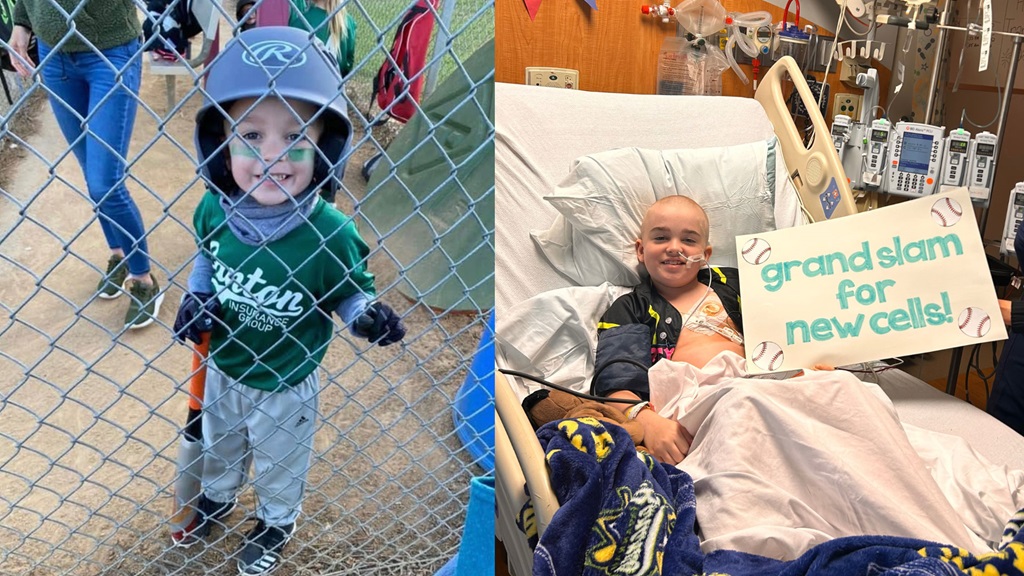
In 2020, then-preschooler Daxton Parks came home from school with more than 20 bruises on his legs.
His mom, Amy, took him to the pediatrician, where blood tests showed he had low platelets and a high mean corpuscular volume (MCV), meaning his red blood cells were larger than normal.
Over the next several years, Daxton underwent multiple bone marrow biopsies, but the results were inconclusive.
“His aplastic anemia evolved slowly over several years, rather than quickly becoming severe, when all three of the main blood cell types are very low, requiring transfusions,” says Dr. Lyndsay Molinari, a pediatric oncologist and hematologist at Atrium Health Levine Children’s Cancer & Blood Disorders. “Presenting as severe right away tends to be more common, at least for acquired aplastic anemia.”
By 2025, Daxton’s blood counts had declined enough for doctors to diagnose him with severe aplastic anemia.
Understanding severe aplastic anemia in pediatric patients
Severe aplastic anemia is a type of bone marrow failure in which the body doesn’t make enough red blood cells, white blood cells and platelets. These cells carry oxygen, fight infection and help the blood clot.
“It can be inherited — the natural progression of a known genetic condition — or acquired from infection, medication or most often, an unclear, but thought to be autoimmune cause,” says Molinari.
Treatment may include immunosuppressive therapy or a bone marrow transplant, with the approach depending in part on whether a suitable donor is available.
Because Daxton’s sister was not a full match, his referring hematologist started him on immunosuppressive therapy with cyclosporine and anti-thymocyte globulin (ATG).
When Daxton’s blood counts did not improve enough, a bone marrow transplant became the next step.
Staying active through aplastic anemia treatment

Despite years of monitoring his condition, Daxton had been able to lead a fairly typical childhood with some precautions.
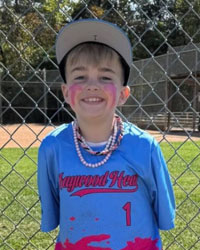
“He couldn’t do contact sports, but was the second baseman on his baseball team,” says Amy.
In April 2026, Daxton underwent a bone marrow transplant at Atrium Health Levine Children’s Hospital.
Even during treatment, his energetic personality came through.
“He was such a trooper and went through chemotherapy, still running a mile on the treadmill and playing pickleball with his nurses,” says Amy.
His friends also stayed close, calling regularly to check on him. The Levine Children’s nurses got to know them too.
“His nurses even learned his friends’ names,” says Amy.
A bone marrow donor who changed Daxton’s life
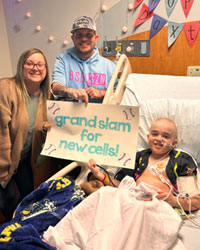
Daxton’s bone marrow donor was a stranger who turned out to be a perfect match.
“I’m so thankful for that person,” Amy says. “They were an absolute blessing. Hopefully, one day we’ll get to meet them and thank them for changing his life and our lives. They will always be in our prayers.”
Since his transplant, Daxton has continued to take precautions while his immune system recovers. He enjoys playing video games, following baseball and football, and spending time with friends. As his recovery continues, he's been able to safely connect with friends outdoors and enjoy some of the activities he loves most.
Amy says her son’s outlook has helped the family through difficult months.
“He’s made it so easy on me,” she says. “His spirits have kept it all together. He is the bravest kid.”
Molinari says there is more than an 80% chance that Daxton’s donor marrow will continue producing healthy blood cells without the need for another transplant. If a second transplant were ever necessary, she says those procedures can also be successful.
Support throughout the bone marrow transplant experience
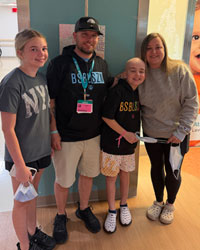
Amy remembers the many ways the Levine Children’s team helped make a difficult experience more manageable for Daxton and his family.
His physical therapist set up a pickleball net so he could play with members of his care team. Daxton got to see his favorite WWE wrestler over FaceTime and another patient’s family gave him a signed baseball bat from his favorite team.
For Molinari, getting to know Daxton meant connecting with him beyond his diagnosis.
“I enjoyed connecting through our mutual love of baseball and not just getting to know Daxton but his entire family throughout this journey,” she says.
“He’s a very bubbly, high-spirited kid,” adds Amy. “He gets along with everybody. He’s a sweet soul.”
Amy hopes sharing Daxton’s story will raise awareness of pediatric aplastic anemia and encourage parents to pay attention when something seems unusual.
“Without taking him to the doctor for some bruises, there’s no telling how long he would have gone before we figured out what happening,” she says.
Now, Daxton and his care team are looking ahead to a milestone that feels extra-special: seeing him return to the sport he loves.
“Transplant for aplastic anemia is a journey that can have many ups and downs and our team is here to navigate that journey with you and to celebrate important milestones along the way,” Molinari says. “The milestone we are all looking most forward to is seeing Daxton back on the baseball diamond next spring. I hope to be there to cheer him on.”
Learn more about the nationally ranked pediatric cancer and blood disorders care at Atrium Health Levine Children's Hospital.
Related Posts

News
A Perfect Match, A Brighter Future: Daxton’s Bone Marrow Transplant Journey

News
Could Space Hold Clues to Better Cancer Treatment? Wake Forest Institute for Regenerative Medicine Researchers Aim to Find Out
