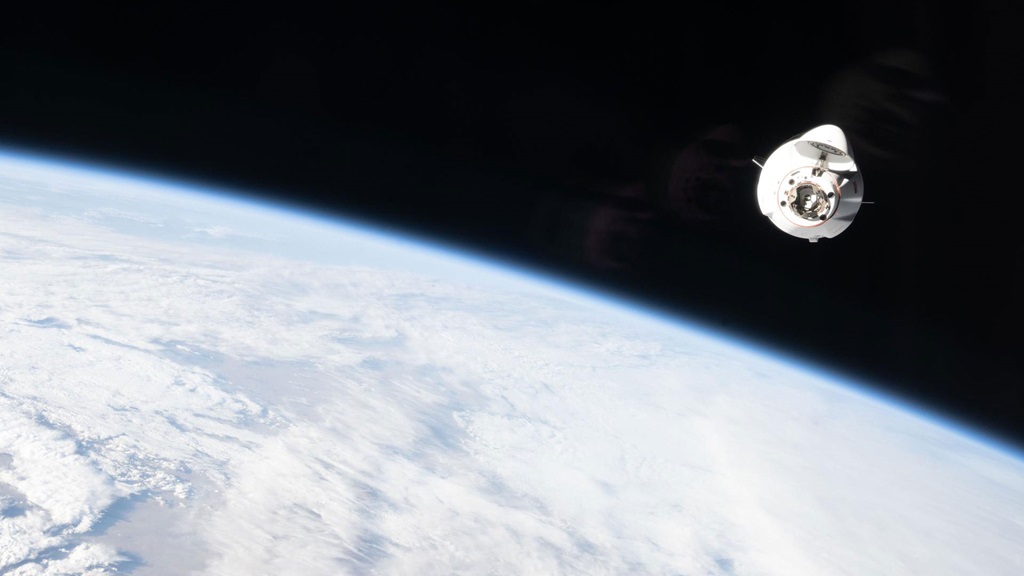
What happens when cancer cells leave Earth?

It sounds like science fiction, but for researchers at Wake Forest Institute for Regenerative Medicine (WFIRM), it's reality — and the focus on ongoing research that could provide answers to how to make cancer treatment more effective for colorectal cancer patients.
In an experiment called Tumor Avatars in Space, or TAVIS, researchers are studying models of colorectal cancer aboard the International Space Station to see whether microgravity changes how tumor cells respond to chemotherapy.
And if those tumors respond differently in space, scientists want to understand why.
“If microgravity makes these tumors more responsive, we can look for the genetic changes behind that and try to induce the same changes here on Earth,” said Shay Soker, Ph.D., a WFIRM professor and principal investigator of the study. “It’s similar in spirit to immunotherapy, which makes tumors more visible to the immune system. The tumor can run, but it can’t hide.”
Why space?
The space environment can influence biological systems in ways that researchers cannot fully reproduce on Earth.
That gives scientists an opportunity to study how cells behave under different conditions and whether those changes reveal something that could ultimately be useful for human health.
“The International Space Station provides a unique research environment that allows us to study biological processes under conditions that cannot be reproduced on Earth,” said Anthony Atala, M.D., director of WFIRM and co-principal investigator of the study. “By examining how these tumor models respond in microgravity, we hope to gain new insights into tumor biology and treatment response that may ultimately benefit patients.”
The TAVIS experiment launched Oct. 13 from Cape Canaveral Space Force Station in Florida. The cancer models aboard the mission are tumor organoids, or small replicas grown in a laboratory by WFIRM scientists from cancer cells obtained from patients with colorectal cancer.
Think of an organoid as a miniature model that gives researchers a way to study some characteristics of a patient’s tumor outside the body.
For TAVIS, those organoids serve as “avatars,” or stand-ins, for patients’ tumors.
Space vs. Earth
The researchers designed TAVIS around a comparison.
One group of tumor organoids is being studied and treated with chemotherapy in space. A matching control group remains on Earth and receives treatment here.
The important difference is the environment: microgravity versus Earth’s gravity.
When the samples return to Earth, researchers will compare the two groups to determine whether the cancer cells responded differently to chemotherapy.
If they did, that finding would lead to the next question: What changed inside the cancer cells?
Researchers could examine genetic differences, including possible changes in cancer-cell metabolism. Those clues could help identify biological pathways that influence how a tumor responds to chemotherapy.
More effective treatment, fewer side effects
That question matters because chemotherapy doesn’t work equally well for every patient. For some people, a tumor responds strongly to chemotherapy. For others, chemotherapy may be less effective.
One possible way to overcome that resistance is to increase the chemotherapy dose. But higher doses often are not possible because of the side effects they can cause.
The TAVIS team is exploring another possibility.
Rather than simply giving patients more chemotherapy, this research explores the possibility of making a tumor more sensitive to the chemotherapy a patient is already receiving.
If researchers discover that microgravity causes genetic changes that make the tumor models more responsive to treatment, they can begin investigating whether those same changes can be reproduced on Earth.
Eventually, that could include identifying small-molecule drugs capable of triggering the beneficial changes and combining those drugs with chemotherapy.
The long-term goal would be to help chemotherapy work more effectively at doses patients can better tolerate.
Considerable research remains before scientists know whether that approach will be possible. TAVIS is designed to uncover biological clues that could point researchers in that direction.
Space as a laboratory
TAVIS is part of a broader effort to use the International Space Station not simply to learn what happens to biological systems in space, but also to gain insights that could benefit human health on Earth.
By studying changes under the microgravity conditions in space, scientists may be able to uncover biological processes in a new way.
In the case of TAVIS, space becomes a laboratory for asking a very Earth-bound question: Can we find a way to make cancer more vulnerable to treatment?
The project brings together Wake Forest Institute for Regenerative Medicine, BioServe Space Technologies at the University of Colorado Boulder and Axiom Space. It is funded by the Center for the Advancement of Science in Space, which manages the International Space Station National Laboratory, and was selected through the National Lab’s Igniting Innovation collaboration with NASA’s Biological and Physical Sciences Division.
For researchers, sending tumor models into space is not the destination; it's the journey to find ways to improve lives on Earth.
Related Posts

News
Could Space Hold Clues to Better Cancer Treatment? Wake Forest Institute for Regenerative Medicine Researchers Aim to Find Out

News
From Paramedic to Patient: Doug’s Experience With Lung Cancer and Clinical Research
