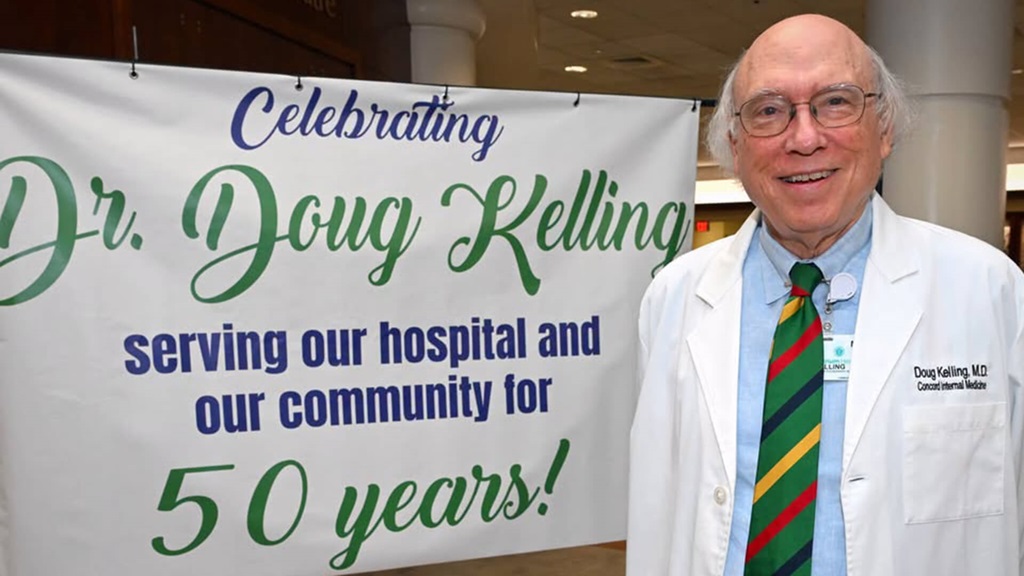
After 50 years of caring for patients, Dr. Doug Kelling took his longest vacation. Two weeks, to be exact.
Before leaving, however, the Atrium Health Concord pulmonologist and internal medicine physician made sure his patients had one more thing: his cell phone number.
While many people go on vacation to disconnect, Dr. Kelling stayed connected. It was a small gesture that said a lot about the physician who has spent five decades caring for generations of patients, making sure they've never been without someone to call when they needed help.
As his daughter, Atrium Health pediatrician Dr. Porter Peterson, put it: “Practicing medicine isn't simply what my father does. It's who he is.” His approach to medicine has helped shape who she is as a doctor today.
"My dad has always had just a love for medicine," Peterson said. "I think he was genuinely excited that I was going into it and never once tried to sway me toward anything else."
Some of Peterson's earliest lessons about medicine came from watching her father interact with patients. He knew their stories, understood their challenges and remained a steady presence in their lives long after an appointment ended. The relationships he built shaped her understanding of what it means to care for people.
From rural Missouri to Harvard
Long before he became a physician in Concord, Kelling grew up in Waverly, Missouri, a town of roughly 800 people. To put that in perspective, Atrium Health Carolinas Medical Center has more beds than there were people in his hometown.
Medicine was already part of the family story. His father, grandfather and uncle were all physicians, and becoming a doctor felt as natural to him as growing up in a small farming community.
"There was never a discussion, no pressure, no nothing," Kelling said. "It was just, I'm going to be a doctor."
His path to medicine would eventually take him from rural Missouri to Harvard University, though not without obstacles.
His high school graduating class had only 24 students. There were no foreign languages, no physics and few of the advanced courses that many college-bound students took for granted. After deciding he wanted to attend Harvard, he wrote the admissions office, requested an interview and traveled with his parents to Cambridge.
When he arrived on campus, he immediately felt at home. "I put one foot in Harvard and said, 'This is where I belong."
But getting there required determination and overcoming a number of logistical hurdles. Kelling had to transfer schools during his senior year to obtain additional coursework, take the SAT for the first time and prove he could succeed alongside students who had come from some of the nation's most prestigious preparatory schools.
The transition was difficult. By his own account, he struggled early. Still, he never thought about walking away. "There was never a thought about quitting," he said. "It was just a thought about pushing through."
Eventually he caught up, earned a degree in biochemistry, worked alongside Nobel Prize-winning scientists and graduated Magna Cum Laude from Harvard Medical School before completing his training at Duke University.
Despite training at some of the nation's most prestigious institutions, Kelling was ultimately looking for something familiar: a community where he could build relationships and put down roots.
Kelling arrived in Concord in July 1976 and never left, because what he found reminded him of home.
The textile workers and families who built the community shared many of the same qualities he had admired growing up around farmers in Missouri. They worked hard, cared deeply about their families and faced challenges with quiet perseverance.
"These were my kind of people," Kelling said. "They were the type of people I was put on this earth to take care of."
Despite advancements, the patient always comes first
Kelling has practiced long enough to witness extraordinary changes in medicine.
When he started, there were no CT scans or MRI machines. Routine cancer screenings were far less common. Many medications physicians now prescribe every day were still years away from development.
The focus of medical care looked different too: much of healthcare centered on helping people survive serious illness. Today, advances in medicine have extended lives and changed expectations. Patients are living longer, often while managing chronic conditions that require ongoing attention and support.
The conversations have evolved with those changes. "It changed from death to quality," Kelling said. Helping patients maintain independence, navigate chronic illness or make difficult decisions about their future has become a larger part of modern medicine.
Through every change, one principle has remained constant: "The patient always comes first." Peterson said that commitment has defined her father's career.
Despite changes in healthcare delivery, she sees the same physician today that patients met decades ago.
"To have gone through so many changes in medicine but still be, at his core, the same physician he was 50 years ago gives me even more appreciation and admiration for him," she said.
The “Angels” of Cabarrus County
Spend enough time talking with Kelling about medicine, and the focus quickly shifts to others. He speaks about grandparents raising grandchildren, spouses caring for loved ones and families quietly making sacrifices every day.
"Every day, I'm blessed because I see angels," he said. Kelling jokes that he serves as the "chief executive officer for Angels of Cabarrus County," reflecting a belief that has guided his career: his role is not to be the hero, but to help people care for one another.
That perspective laid the foundation for how he practiced medicine. Peterson remembers watching her father look beyond symptoms to understand the whole person, including the family, financial and personal challenges affecting their health.
"To be a good physician, you need to embrace the whole person and understand all the dynamics that can play into someone's health," she said.
Some of the stories Peterson hears most often are about his presence during life's hardest moments.
"He will stick by his patients and their families until the very end," she said. "I've had so many people tell me what a presence he was through the final days of a family member's life." As Kelling puts it, those relationships are built on trust and listening. "Patients know," he said. "They can tell. Are you listening to them?" In the end, it's that willingness to listen that defines both his approach to medicine and the lasting impact he leaves on patients and their families.
A legacy beyond his own patients
For Kelling, the future is about more than looking back on a lifetime of service. It is about helping shape the next generation, ensuring the lessons that guided his career continue to benefit patients, families and the community for years to come.
Teaching is also a significant part of the legacy Kelling hopes to leave behind. Over five decades, he helped educate more than 200 physician assistants, more than 50 nurse practitioners and more than 50 PharmD students. Just as he did with patients, he emphasized listening, empathy and relationships, lessons that will continue to shape care long after his own career ends, which, by his own account, won’t be anytime soon.
That dedication to serving others, whether at the bedside or in the classroom, remains at the heart of his work today.
Before leaving on that long-awaited vacation, he made sure every patient knew how to reach him. After all, some habits are hard to break.
And for a physician who has spent a lifetime putting patients first, staying available simply comes naturally. Fifty years after arriving in Concord, he remains committed to the calling that first drew him to medicine: caring for people, supporting families and helping others carry that work forward.


