 Thanksgiving looks different to Demotris Smallwood this year.
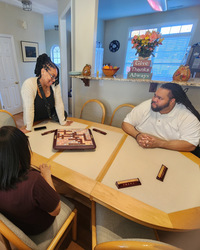
A year ago, she was preparing for dinner with a friend and looking ahead to the holidays. Smallwood was a nursing student, a wife and a mom with a daughter approaching her senior year of high school. Life was busy, familiar and full of plans.
Then, during Thanksgiving week, everything changed.
Smallwood experienced a spontaneous coronary artery dissection, or SCAD, a condition in which a separation develops within the wall of a coronary artery and can block blood flow to the heart. Her heart was severely weakened. Within days, conversations that had once been about school, family and the holidays had become conversations about how to save her life.
Choosing more time

Doctors initially supported Smallwood’s heart with a temporary mechanical pump, but her health was not improving.
“Her heart was not getting better,” said Dr. Barbara Pisani, medical director of the VAD Program at Atrium Health Wake Forest Baptist.
A heart transplant was not the best immediate option because antibodies in Smallwood’s body increased the risk of rejection. Dr. Pisani and her care team recommended a left ventricular assist device, or LVAD, a mechanical pump that helps a weakened heart circulate blood through the body.
For Smallwood, saying yes was not easy.
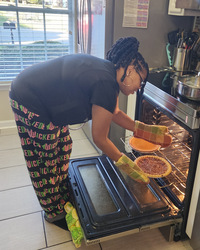
She loved swimming and being in the water, things she knew would change with an LVAD. At first, she thought about what she would have to give up. Her care team helped her to think instead about what she could gain: Finishing nursing school, more time with her family and watching her daughter enjoy all her senior year moments.
“I want to be there,” Smallwood said. “I want to see graduation. I want to see prom. I want to spend time with her.”
Smallwood received her LVAD in January 2026.
Thirty years of giving patients more time
Smallwood’s second chance comes during a milestone year for Atrium Health Wake Forest Baptist Medical Center.
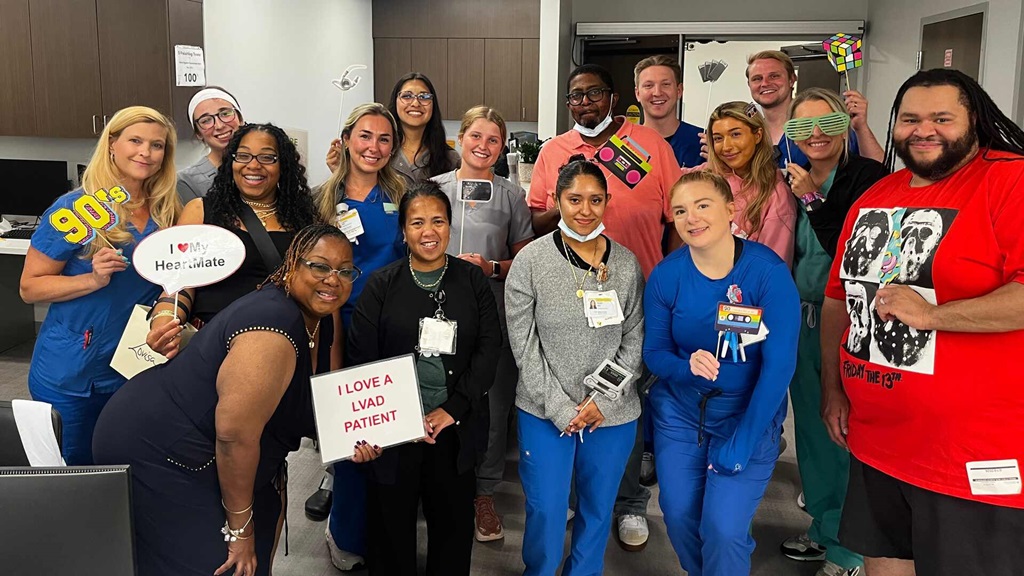
Physicians there implanted the medical center’s first ventricular assist device in 1996. Thirty years later, its VAD program has helped save 227 lives. That translates to more than 152,000 additional sunrises and sunsets, and time with the people they love.
“Over the past 30 years, ventricular assist device therapy has transformed what’s possible for patients with advanced heart failure,” Dr. Pisani said. “These milestones represent more than numbers, they reflect the lives extended, the time gained with loved ones and the dedication of teams committed to delivering this highly specialized care every day.”
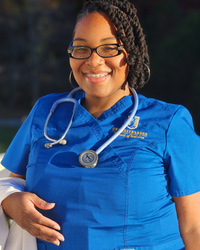
For Smallwood, those numbers have become something much more personal.
They look like another Thanksgiving with her family.
They look like returning to school.
They look like a daughter moving closer to prom and graduation.
And they look like plans that can still be written on the calendar.
Grateful for the life still ahead
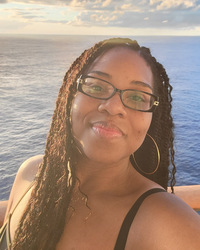
The past year has not always been easy. Smallwood is grateful to be alive, but she also had to make peace with the life she expected and the things that changed.
“Two things can be true at the same time,” she said. “You can be grateful and at the same time grieving the things you are going to miss.”
This Thanksgiving, gratitude does not mean pretending the difficult parts did not happen. For Smallwood, it means recognizing everything she still has in front of her.
“I am here for a reason,” Smallwood said. “I basically got a second chance and the LVAD did that for me.”

