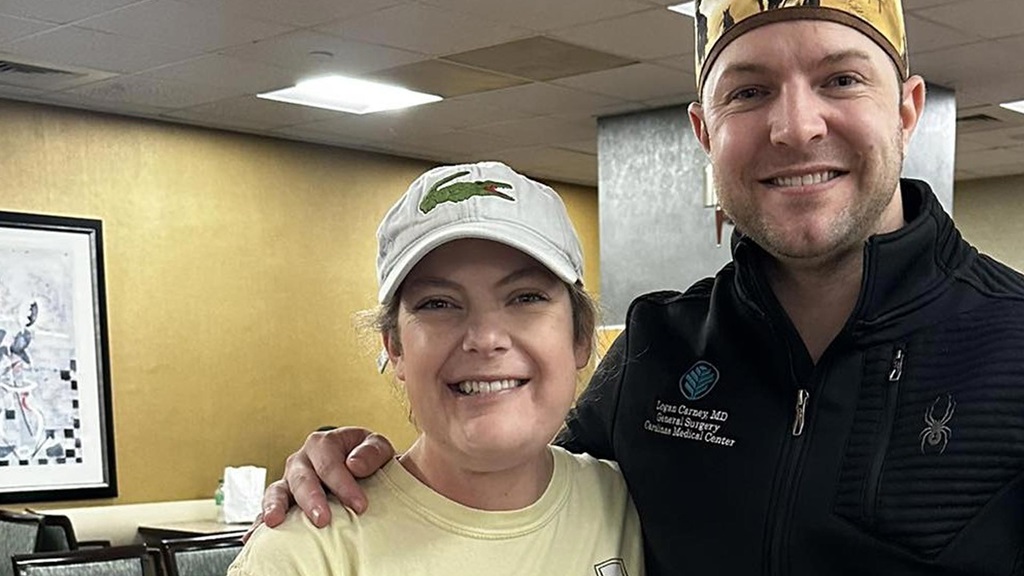
When Jennifer Quick, 36, arrived at Atrium Health with a life-threatening surgical complication, Dr. Logan Carney didn’t think she would survive the night.
“Jennifer was one of the sickest patients I’ve taken care of,” says Carney, a board-certified general surgeon and current surgical critical care fellow at Atrium Health. “The night she came in, I thought there was probably a 1% chance of survival.”
A tongue cancer diagnosis and surgery
Jennifer, a high school math teacher, wife and mom of two, had been diagnosed with tongue cancer and underwent surgery in December 2025. A few days later, she knew something was wrong.
“I felt really crummy, I wasn’t sleeping well and I had pain and swelling in my neck,” she says.
The next day, she began vomiting and collapsed to the ground. Her husband, Brian, immediately called 911. By the time the paramedics arrived, Jennifer’s blood pressure had dipped critically low: 36/20.
“At that point, I was in septic shock,” says Jennifer.
Jennifer was taken to her local hospital, then transferred to Atrium Health for a higher level of care.
Emergency care in the ICU
“When Jennifer arrived at the hospital, she was in what I would call profound vasoplegic syndrome in septic shock,” says Carney. “Her blood pressure was extremely low and her heart rate was extremely high. She was exceedingly sick.”
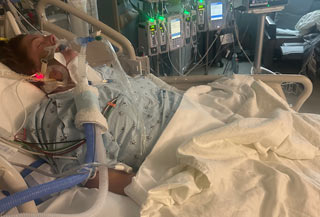
All of this happened on Dec. 18. Jennifer remembers little after that until Dec. 31. For much of the story of her early days in the intensive care unit (ICU), she relies on what Brian and her medical team later told her.
“My heart was failing, my kidneys were failing, my lungs were having a hard time — my organs were shutting down,” she says.
Right away, Carney and his team placed two central lines and an arterial line, which allowed them to deliver medications and fluids while closely monitoring her blood pressure. Jennifer needed four vasopressor medications, which are used to raise dangerously low blood pressure. That level of support is rare, Carney says, but Jennifer needed it.
Jennifer also required multiple salvage therapies, including steroids, methylene blue and multiple doses of hydroxocobalamin. Her medical team also considered ECMO (extracorporeal membrane oxygenation) at multiple points, a form of advanced life support that can temporarily help the heart and lungs when the body is in crisis.
“When I met her husband, Brian, in the waiting room, it immediately struck me that Brian and Jennifer were both close to my age,” says Carney. “I pictured myself and my wife in their shoes and could feel how dire the situation was.”
Each time Carney updated Brian about Jennifer’s condition throughout the night, he was struck by Brian’s optimism and hope in the direst circumstances.
“He had this positive energy I didn’t understand,” says Carney. “Every time I talked to him, he would smile and say he understood. He kept saying, ‘God will take care of her and you all.’”
In a twist of fate, Brian had had a life-threatening health event himself several years before and had to be placed on ECMO for temporary life support.
“Brian was even closer to death than Jennifer was,” says Carney. “It’s a miracle the two of them are still alive. He knew that if he could survive something like that, there was hope Jennifer could too.”
“We’ve had a wild ride of a marriage,” says Jennifer. “We really took ‘in sickness and in health’ to a whole new level.”
Jennifer’s life-saving treatments in the ICU
In the ensuing days in the ICU, Jennifer needed multiple bedside surgeries and numerous medications.
“She was too unstable to go to the operating room,” says Carney.
Jennifer had a necrotizing infection, a rare bacterial infection that destroys the body’s tissue. Carney and his team surgically removed infected tissue from the surgical site in her neck several times.
Days later, some of her clinical markers got so high that Jennifer’s medical team was concerned she was developing necrosis in her intestines. The team performed a bedside laparotomy (a surgery to access the abdominal cavity) to make sure her intestines were still functioning.
Because her blood pressure had been so low, Jennifer also needed a ventilator and was not very responsive. Carney worried about what her mental status would be if she survived. Fortunately, her cognition was fully intact.
Jennifer’s medical team had glimmers of hope as she responded, at least temporarily, to the therapies they gave her.
“Both Jennifer’s response to the therapies and Brian’s attitude gave our whole team hope,” says Carney.
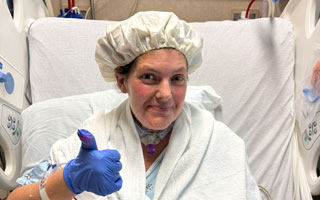
By December 24, Jennifer started to turn a corner. Her medical team called her their “Christmas miracle.”
Jennifer was in the ICU for nearly a month and Carney cared for her during the majority of her stay.
A chance reunion with Dr. Carney
In May, after a follow-up appointment with her oncologists, Jennifer, Brian and their son decided to stop by the ICU to thank the team for helping her make a full recovery. As they reached the elevator doors, they ran into Carney, who was stepping off the elevator after a 24-hour shift.
“It was a very special feeling to reconnect with Jennifer,” says Carney. “I’d had a particularly brutal few weeks with patients who couldn’t be saved. To have a success story like Jennifer, who was on the brink of death and is now alive, healthy and living life with her family, that provides a level of joy I’m not sure I can describe with words. Seeing her fully recovered has reinvigorated my entire perspective — I’m just so thankful.”
Since her stay in the ICU, Jennifer has completed cancer treatment, including multiple rounds of radiation therapy. She’s looking forward to getting back in the classroom, coaching a summer swim league and the high school swim team, and taking a family beach trip.
“Dr. Carney never gave up on me,” says Jennifer. “I thanked him for believing I could come out of this and for saving my life.”
Learn more about critical care at Atrium Health.


