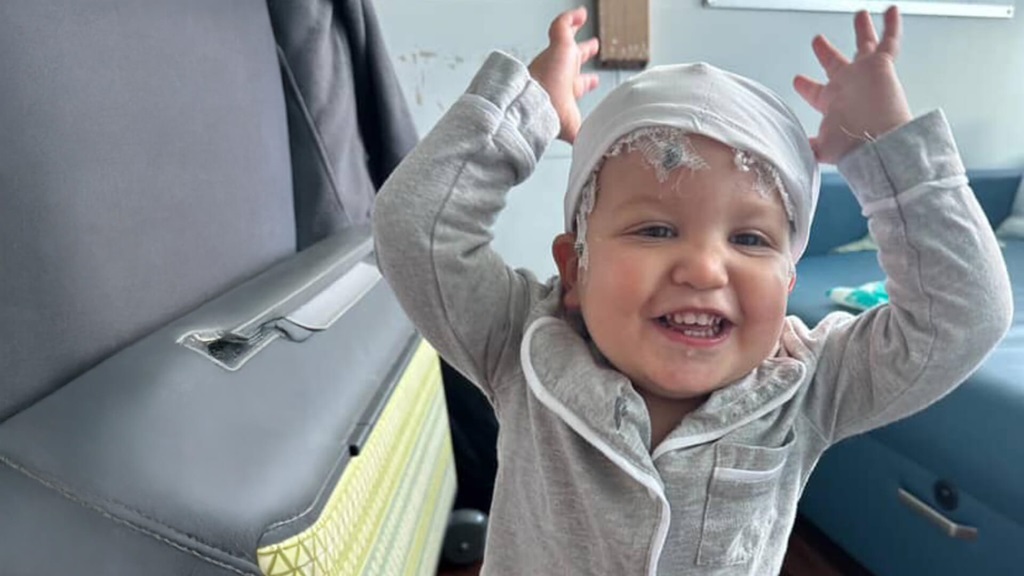
 When Emily Thornburg welcomed her son, Raiden, into the world, he was a healthy, thriving baby boy. But one quiet night, when Raiden was around three months old, everything changed.
Emily, a nurse herself, was feeding him when she noticed sudden, jerky movements.
“Being a nurse, at first I thought he was having reflux,” she says. “I tried to hold his arms down and he pushed his arms in a rhythmic movement. It seemed like some sort of spasm or how we see newborns present with seizures.”
Alarmed, Emily called her best friend, a neonatal intensive care unit (NICU) nurse, in the middle of the night. On her friend’s advice, she took Raiden to the emergency department at Atrium Health Levine Children’s Hospital.
Raiden was admitted for observation due to his unusual movements and a mild fever.
“I thought maybe he was having febrile seizures because he had a fever,” says Emily. “They did a whole metabolic workup.”
After a full day of testing, everything came back normal and Raiden was cleared to go home.
“Going into the ER, they were very kind,” Emily says. “They talked with me about every decision, made sure I was comfortable, and explained everything before we were discharged.”
Although Raiden’s testing came back clear, the team made sure he was referred to a neurologist for follow up care.
When Raiden’s symptoms continued
A few weeks later, Emily noticed the odd movements hadn’t gone away. By then, she had just started her new job as a triage nurse at a Levine Children’s outpatient pediatric clinic in Charlotte.
“Having previously been a post-partum nurse, I wasn’t too familiar with Raiden’s age group since he was a little older than a newborn,” she explains.
Emily shared her concerns with the pediatricians she worked alongside.
“They gave me things to watch out for to be aware of possible seizure activity,” she says.
Soon after, Raiden began having tremors, spells where he’d stare into space and moments of unresponsiveness.
“I thought maybe he was just being an infant,” Emily says. “My colleagues encouraged me to follow up with neurology again.”
While waiting for Raiden’s appointment, Emily witnessed what looked like an absence seizure. She brought him back to the emergency department, where the team admitted him for epilepsy monitoring at Atrium Health Levine Children’s Jeff Gordon Children’s Center.
There, specialists began an in-depth evaluation of Raiden’s brain activity. This advanced care is part of Levine Children’s Level 4 epilepsy monitoring unit — the highest level of accreditation and the only pediatric unit of its kind in the region.
Searching for answers
 “I saw Raiden in the clinic for evaluation of tremor-like movements at the age of 10 months,” says Dr. Cecilia Fernandes, a neurologist at Atrium Health Levine Children’s. “We usually see this commonly in young infants less than 1 year and call it tremulousness. However, we have to rule out seizure-like activity, so we ordered an EEG.”
An EEG (electroencephalogram) monitors electrical activity in the brain using sensors placed on the scalp.
“We put stickers on the scalp and this monitors brain wave activity,” Dr. Fernandes explains. “I tell families we test how nerves are talking to each other. If some nerves are talking in a different language, we can pick this up and it makes us suspicious for seizures. What we look for on EEGs are nice smooth beach waves — that’s normal. If we see pin-like spikes, that is abnormal. Raiden’s EEG was normal, so it was happy news for all of us.”
“Raiden’s kind of a mystery,” adds Emily. “Everything looked great and that was super reassuring. There wasn’t anything obvious on the EEG to explain epilepsy or a seizure. They think he may have shutter spells, which are common in newborns or toddlers — where they shake if they’re excited, angry, peeing or pooping. The doctor and the physician assistant were incredible. I felt reassured.”
With a clear EEG, Raiden’s medical team continues to monitor him closely. Currently, Raiden still experiences occasional episodes, usually every other week, often around breakfast or after naps.
“He still sometimes gets scarier symptoms, like blue around his lips or altered awareness,” Emily says. “But I’m aware and make sure they don’t escalate further.”
For Emily, this journey has shaped both her personal and professional life.
“It’s changed the way I try to reassure my patients,” she says. “The way providers have spoken to me showed me the importance of being calm and letting patients and families know I understand where they’re coming from.”
Fernandes says Raiden’s development is a positive sign.
“What’s most reassuring for me is his development continues to be normal, and this goes against anything big, bad and serious,” she says. “We are watching him closely for now, and his episodes are reducing in frequency, which is what I expect.”
Compassionate care for Raiden and his family
Emily says her family’s experience at Jeff Gordon Children’s Center and Levine Children’s Hospital was nothing short of amazing.
“They’d check on Raiden and I, asking if we needed anything and bringing him toys,” she says. “They made us a playroom reservation so Raiden could get his wiggles out. They were super patient and kind.”
Today, Raiden is an active, joyful toddler.
“He loves to climb and hang on things,” says Emily. “He loves people and other kids and loves to hug his classmates at daycare. He loves to dance and is a fun guy. Even in the hospital, he was having a blast and playing with everyone.”
Fernandes offers advice for parents who may be facing similar worries:
“I like to tell parents to trust their instincts and reach out to a doctor if they have any concerns,” she says. “Most of the time, infants and toddlers will have funny-looking movements that make parents anxious or suspicious. Please don’t just research things online. Instead, come and speak to us in person so we can explain and reassure you.”
A new perspective and purpose in nursing
 Emily says her family’s experience inspired her to take the next step in her career.
“I just started nurse practitioner school for pediatrics,” she says. “This experience inspired me. I loved pediatrics before and this made me realize that taking personal life experience and using it in practice can make a world of difference.”
She’s deeply grateful for the care Raiden has received from his medical team.
“I’m glad he’s totally fine and I did everything I had to do to make sure he was OK,” Emily says.
For Fernandes, moments like these are what make her work so rewarding.
“The best part of my job is to see children smile when they come to my clinic,” she says. “It always warms my heart and makes my day. Another beautiful part of my job is maintaining good relationships with families so they can trust me with any concerns that weigh on them.”
Learn more about neurology care at Levine Children’s.


