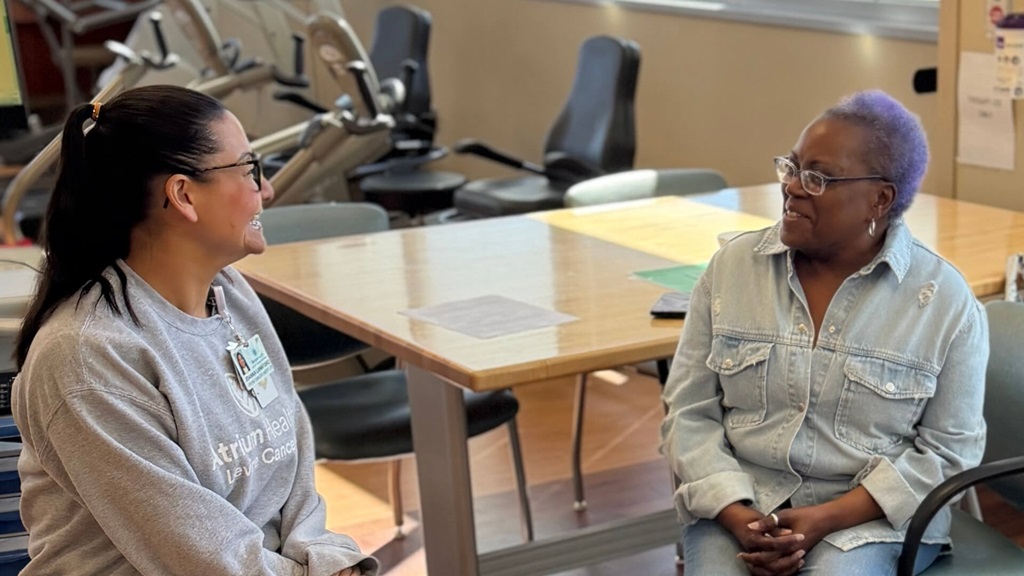
 When Angela Mann, 63, was diagnosed with stage IV breast cancer in February 2024, she was already facing more than the shock of the diagnosis. The disease had metastasized to her hip. She had lost her appetite, struggled to keep food down and later developed a calcium deficiency caused by one of her cancer treatments.
She had also lost something deeply personal: her independence. Angela was using a wheelchair and couldn’t stand or walk on her own.
“I was in really bad shape,” she says.
But through Atrium Health Carolinas Rehabilitation’s inpatient cancer rehabilitation program, Angela began working toward regaining her mobility and parts of her everyday life. During her two-week stay, she participated in twice-daily physical therapy sessions and once-daily occupational therapy appointments. She also took part in recreational activities led by the cancer rehabilitation team, including gardening and karaoke, designed to keep her moving and engaged.
By the time she completed her two-week inpatient stay, Angela had progressed from a wheelchair to a walker. As she continued outpatient cancer rehabilitation at Atrium Health Levine Cancer, she later transitioned to using a cane, and today she walks only with a limp.
“That’s how successful I’ve been through the whole rehab process, both inpatient and outpatient,” she says.
Cancer rehabilitation at Levine Cancer
Angela’s progress reflects the broader purpose of cancer rehabilitation at Levine Cancer: helping patients manage the physical, emotional and functional effects of cancer and cancer treatment so they can participate more fully in daily life.
Cancer rehabilitation brings together a multidisciplinary team to address the unique needs of people diagnosed with cancer. The program includes:
- Physical therapy
- Occupational therapy
- Speech-language pathology
- Neuropsychology
- Physical medicine and rehabilitation
- Exercise Physiology
The goal is to help patients prevent or minimize impairments, reduce activity limitations and improve quality of life from diagnosis through treatment and survivorship.
For some patients, that may mean rebuilding strength after treatment. For others, it may mean managing cancer-related fatigue, lymphedema, pain, cognitive changes, mobility challenges or the effects of radiation therapy, chemotherapy or surgery.
According to Dr. Vishwa Raj, chief of cancer rehabilitation at Atrium Health Levine Cancer, the program is unique because it brings together Atrium Health Carolinas Rehabilitation and the Department of Supportive Oncology within Atrium Health Levine Cancer. That collaboration allows patients to receive coordinated care across settings and access services designed to help them live as independently as possible.
“As you look at the cancer rehabilitation program and its integration within supportive oncology, the ability to provide multiple services that help both with functionality and quality of life is a very unique paradigm that doesn't exist in most other cancer centers,” says Dr. Raj.
 International recognition of the cancer rehab program
That integrated approach has earned major recognition. The combined cancer rehabilitation program received re-accreditation from the Commission on Accreditation of Rehabilitation Facilities (CARF), with no recommendations for improvement after surveyors reviewed and documented information on more than 3,000 standards during CARF’s most recent survey of the program in 2026.
CARF is an international organization that sets quality standards for rehabilitation programs and supports a patient-centered approach to care. Levine Cancer has been accredited since 2014 and was the first accredited outpatient cancer rehabilitation program. Carolinas Rehabilitation was also the first accredited inpatient cancer rehabilitation program in the world.
For patients and referring providers, the accreditation offers reassurance that the program meets high standards for clinical practice, quality review, outcomes and patient-centered care.
"All of us in the Department of Supportive Oncology are so proud of the CARF accreditation for our cancer rehabilitation colleagues,” says Dr. Declan Walsh, chair of the Department of Supportive Oncology at Levine Cancer. “Kudos to Dr. Raj and all the cancer rehab team."
The program’s work also reflects a growing understanding of how rehabilitation can support patients throughout cancer care.
“Rehabilitation is so important for patient function and quality of life, but we are also coming to realize that the quantity and quality of muscle in an individual is also very important in affecting treatment outcomes and perhaps reducing treatment toxicities,” says Dr. Walsh. “This is a very active area of research.”
Angela’s progress in outpatient cancer rehab
Angela’s progress didn’t stop when she left inpatient rehabilitation. After taking time off from rehabilitation during radiation therapy, she later began outpatient physical therapy to continue building strength, improving mobility and managing pain.
As part of her ongoing care, Angela has tried dry needling and kinesiotaping to help relieve muscle pain and has appointments scheduled for acupuncture and therapeutic massage through the Integrative Oncology section.
“I’ve had nothing but good results,” she says.
Angela is also interested in trying other supportive oncology services like music therapy, which feels especially meaningful given her background in music promotion. In fact, she’s so inspired by the role music can play in healing that she wants to learn more about becoming certified as a music therapist herself.
Now, Angela remains on continuous chemotherapy, and her cancer markers are normal. Just as importantly, she has regained pieces of everyday life that matter deeply to her.
“Driving again was a big deal,” she says. “Just being able to get up and go. I can go shopping, garden, play with my dog and do crafts with my grandchildren again. I can get from one room to the next without requiring help.”
Angela’s advice to others going through cancer treatment and considering cancer rehabilitation is simple: “Try everything. And be good to yourself. Now is the time to be the best self you can be and nobody can be better to you than you.”
For patients experiencing changes in strength, mobility, pain, fatigue, swelling, speech, swallowing, memory, focus or daily function during or after cancer treatment, cancer rehabilitation may help. Talk with your care team about whether a referral is right for you.
Learn more about cancer rehabilitation at Atrium Health Levine Cancer.


