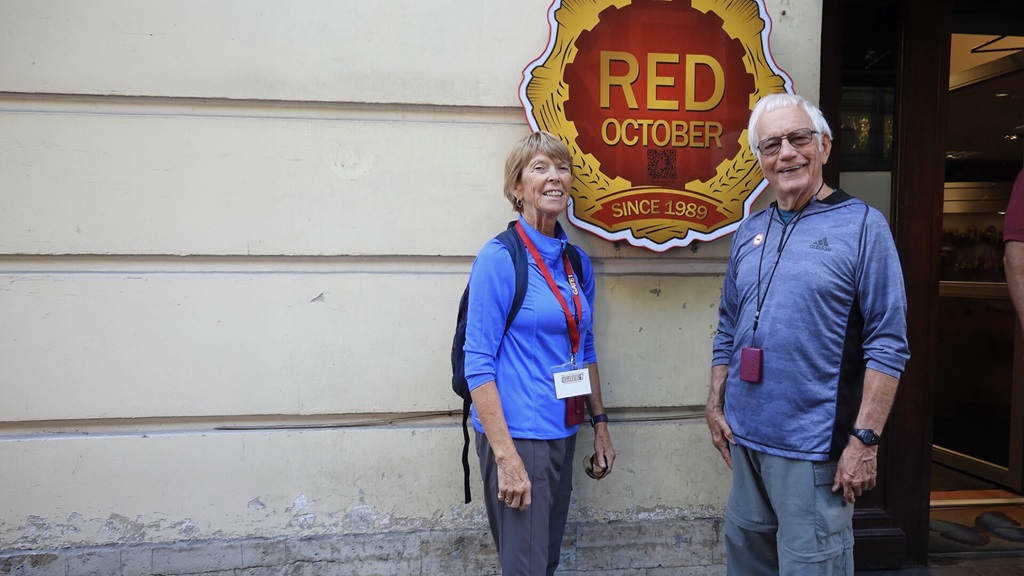
 After more than three decades caring for patients at Atrium Health, Dr. Bill Lorentz never imagined he would one day find himself on the other side of the exam table, especially at nearly 89 years old.
A retired physician who joined Atrium Health in 1974, Dr. Lorentz helped build the organization’s pediatric dialysis and transplantation program from the ground up. Over a 36-year career, he treated generations of families, held leadership roles and witnessed medicine evolve through eras of enormous change. Still, when an unexpected diagnosis occurred, even his deep medical experience couldn’t prepare him for just how different and how advanced care can look today.
Dr. Lorentz initially sought evaluation for abdominal pain, believing gallstones might be the cause. During imaging, however, doctors uncovered something far more concerning: large cysts on the tail of his pancreas, some showing pre-malignant, high-risk features.
What followed was a difficult question, especially given his age: was surgery even an option?
“Ten years ago, we wouldn’t even think about operating on you,” he recalls being told.
Rather than closing the door on treatment, Atrium Health physicians looked for another way — one that balanced surgical risk, recovery time and quality of life. After a comprehensive evaluation confirmed that Dr. Lorentz’s heart and lungs were strong, the care team determined that robotic-assisted surgery could make the difference.
For someone nearly 89, an open abdominal surgery would have meant a large incision and one to two weeks in the hospital just to recover from the incision alone — if surgery was offered at all. The robotic approach changed that equation entirely.
Using advanced robotic technology, surgeons were able to remove the tail of Dr. Lorentz’s pancreas — including the suspicious cyst — along with his spleen and his gallbladder in a single procedure. During the operation, the surgical team also discovered a small mass on his stomach. With consent from Dr. Lorentz’s wife, the mass was removed during the same surgery.
Pathology results later confirmed just how critical the timing had been. The pancreatic cyst showed high-grade dysplasia — advanced pre-cancerous changes that, left untreated, could have progressed to cancer. The gastric mass was identified as a low-grade gastrointestinal stromal tumor (GIST), which was completely removed with negative margins. In a single operation, the surgery not only treated existing disease but successfully prevented future cancer.
Just as remarkable was Dr. Lorentz’s recovery.
 “I was out of bed on the second day following surgery,” he says. “I had basically no abdominal symptoms after the second day in the hospital.”
Although he was medically ready to go home by post-operative day two, his care team kept him slightly longer to monitor labs. He was discharged on day four — far sooner than would be expected with a traditional open operation. When he returned for his two-week follow-up appointment, aside from well-healed incisions, it was difficult to tell he had undergone major abdominal surgery at all.
For Dr. Lorentz, the experience underscored just how transformative robotic surgery has become and how access to that technology isn’t universal.
And robotic surgery isn’t offered everywhere. It depends on specialized training, significant resources and, above all, strong collaboration among surgeons, hospitals and broader health system support. Through these shared efforts, Atrium Health has been able to offer complex robotic procedures, including hepatopancreatobiliary (HPB) surgery, to more patients — expanding options for some who might otherwise have few surgical paths forward.
Dr. Lorentz also points to the people behind the technology, especially his surgeon, Dr. Reames, whose confidence and enthusiasm made a lasting impression.
Asked to reflect on his care overall, Dr. Lorentz doesn’t hesitate. “Nothing but good feelings about Atrium,” he says.
Now home and gradually rebuilding muscle strength, Dr. Lorentz is easing back into daily life. While ongoing mobility challenges and back pain remain from unrelated conditions, he remains grateful for how smoothly this chapter has gone — and for what it allowed him to do next.
Just days after surgery recovery, he was preparing for a major family milestone: his oldest granddaughter’s wedding.
“I’m going to be much more upright,” he jokes, grateful simply to be there.
For Dr. Lorentz, the experience was more than a successful surgery — it was a firsthand glimpse into how far medicine has come. Robotic surgery didn’t just treat his condition; it made care possible when it once would have been out of reach.
“This technique has made it possible to extend surgery into the older crew,” he says — a powerful testament coming from someone who devoted his life to medicine.
To learn more about pancreatic care at Atrium Health Wake Forest Baptist please visit: https://www.wakehealth.edu/treatment/p/pancreatic-cancer-surgery


