

Pharmacy Department
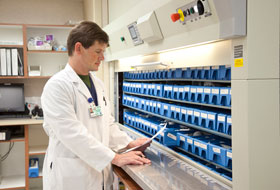
Carolinas Medical Center (CMC) is the largest facility in Atrium Health. An advanced mainframe computer system, computerized physician order entry, Omnicell dispensing machines, Med-Carousel, and McKesson Robot-RX support medication distribution. Approximately 17,000 doses per day are dispensed from the inpatient pharmacy. IV therapy is an integral part of the CMC pharmacy department; in addition to preparation of routine IV admixtures (approximately 1,600 admixtures per day), pharmacists review and prepare approximately 60-70 3-in-1 hyperalimentation solutions and 73 oncologic admixtures per day. The department is also responsible for the preparation of intravenous investigational products.
Pharmacy services are provided 24 hours a day. Decentralized pharmacy services are provided from 7 a.m. - 11 p.m. Clinical staff pharmacists are responsible for order verification, pharmacokinetic monitoring and consults, renal dosing, pharmacy interchanges, including IV to PO, providing drug information and reporting adverse drug events.
 Pharmacokinetic Consultation Services
CMC pharmacists can be consulted to provide assistance to the medical staff in customizing patients’ vancomycin, aminoglycoside, polymixin B and anticoagulation therapy. Pharmacists assess a patient’s clinical condition, review laboratory data, determine the appropriate regimen, write progress notes and order medication and additional laboratory values, if necessary. Patients are followed daily by the pharmacy and adjustments in therapy are made as needed to achieve desired therapeutic outcomes.
Rounding with Physician Teams
Clinical team leaders participate in physician rounds for select teams. Teams include internal medicine, infectious diseases, hematology/oncology, clinical toxicology, cardiac ICU, medical ICU, surgery/trauma ICU, pediatric hematology/oncology, pediatric ICU, pediatric cardiology ICU, neonatal ICU, solid organ transplant, and blood and marrow transplant. During rounds, pharmacists review patient drug profiles, make recommendations to individualize medication regimens, monitor for adverse effects, and suggest alternative regimens when warranted. Interventions are documented in the hospital’s intervention database.
Medication Use Evaluation (MUE) and Adverse Drug Reactions (ADRs)
Pharmacists are responsible for assessing various drug therapies and pharmacy services to identify areas for improvement. Medication use evaluations are conducted as quality assessment projects designed to improve medication utilization. All pharmacists participate in the assessment and documentation of ADRs. Clinically significant ADRs are reported to the Pharmacy and Therapeutics Committee for a focused review.
Atrium Health Investigational Drug Services
 Investigational drug services are provided by pharmacy upon request from researchers receiving IRB approval.
Services include:
- Preparation and coordination of clinical trial medications
- Maintenance of inventory dispensing records
- Assurance of compliance with state and federal regulations for handling of investigational drugs, and
- Assistance with blinding/randomization of drug therapies
Additionally, a pharmacist maintains a membership position on the IRB.